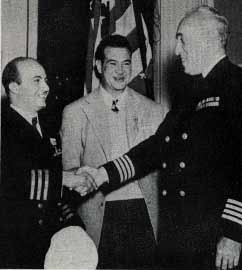
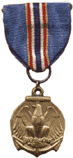
Merchant Marine Heroes: Meritorious Service Medals Awarded "for Conduct or Service of a Meritorious Nature" during World War II
*Indicates award made posthumously
The dates listed are for presentation of the Medal or the date of the War Shipping Administration Press Release.We would appreciate photos, additions, and corrections to this list.
Accord, Leroy W.
Able Seaman, SS John Howard Payne
In March 1945, the SS John Howard Payne, was requested by radio to locate and assist possible survivors of an Army plane which had crashed at a given location in the Pacific Ocean seventy miles distant from the ship's position. The master immediately proceeded at full speed to render assistance. On arrival in the area, during darkness, a systematic search was instituted and continued for several hours until a flare was sighted which proved to be from the plane's rubber life raft supporting two men. Weather conditions were unfavorable for rescue operations. The sea was rough and there was a heavy swell running which caused the ship to roll through an arc of 28 degrees. A lifeboat, manned by the chief mate and six others, was lowered with great difficulty and proceeded on its precarious mission. The master maneuvered his ship to afford a lee for the boat. The removal of the two men from the raft and recovery of the boat and personnel were accomplished with great difficulty and at very definite risk to the rescued men and boat's crew. Feb. 11, 1947Adams, William
Master, SS Charles Morgan 06/10/44
Captain William Adams, was master of the SS Charles Morgan. The ship had delivered her cargo to a European port, reloaded nearly 500 Army personnel and several hundred tons of equipment for the Normandy beachhead. After discharging this equipment and debarking nearly all soldiers in the initial invasion, the vessel was struck in No. 5 hatch by a bomb, causing her to settle by the stern in about 33 feet of water. Fires were started and several men killed. Getting all fires under control, Captain Adams searched all quarters for possibly trapped and injured men and left the ship only after she was declared a derelict by the U.S. Navy salvage officer. At low tide he and eleven of his crew volunteered to reboard the ship in spite of continued enemy action. Pumps were manned to keep the engine room dry and make possible the salvaging of valuable stores and equipment. [Captain Adams lived in New Orleans, LA and was born in Palou, Armenia in 1912. His mother, Mrs. Shoushan Dolbashian, lived in Providence, RI. He attended Fort Trumbull USMS Officer School.] Sep. 22, 1945Adams, William M.
Ordinary Seaman, SS William Tyler Page
When his ship, the SS William Tyler Page, was engaged in the Normandy landing operations, an L.S.T. loaded with troops, hit a mine and was blown apart. Six of the surviving soldiers, all wounded, managed to cling to a piece of the wreckage of the landing craft which was rapidly drifting away in the heavy sea then running. Adams, with six of his shipmates, manned a lifeboat and, at great personal risk and by skillful maneuvering overhauled the drifting and tossing wreckage and rescued the six soldiers who otherwise would have perished [Adams was from Providence RI] May 22, 1945Allen, Edward B. Jr.
Cadet-Midshipman (Deck), SS Cedar Mills
Edward B. Allen, was a Cadet-Midshipman (Deck) aboard the SS Cedar Mills when the vessel was enroute from Australia to India and became separated from her French destroyer escort during a violent cyclone. Upon interception of an SOS, the destroyer was located and found to be in distress suffering a 45 degree list, unable to raise steam, food supplies ruined and having lost overboard a number of officers and seamen. Two lifeboats with volunteer crews, including Allen, were launched, and with mountainous seas and a force 12 wind succeeded in transferring most of the destroyer's crew, many of whom were injured. This difficult operation continued for two days. Then operations began to salvage the destroyer. This necessitated securing a life ring to despatch food and water in milk cans to the crew remaining on the destroyer the five days she was in tow. Relieved by a British Man-of-War, the Cedar Mills continued to her scheduled port. [Allen's home was Roselle Park, NJ. He was born in 1923.] Sep. 4, 1945Altman, Edwin
SS Charles GoodyearAmy, Nelson M.
Master, SS Carole Lombard
His ship, SS Carole Lombard, loaded to capacity with a highly explosive cargo, received an SOS from a torpedoed and fast sinking British freighter [Richard James Ricketts] fourteen hundred miles away. Disregarding reported enemy submarine action in the vicinity, he immediately determined the stricken ship's position, plotted the course, and with "full speed ahead", in a rough sea, located the scattered lifeboats spread over a distance of ten miles containing the entire British crew of ninety. Owing to the rough sea and strong winds it was necessary to skillfully maneuver his ship to each lifeboat. The stricken crew, having been four days in the boats, was completely exhausted. However, every man was taken safely aboard, given first aid, food, available clothing, and eventually landed in physically fit condition. His expert seamanship and indomitable will to go to the aid of distressed seamen under the most difficult circumstances, obviously saved the lives of these ninety men. [Amy lived in Baltimore, MD] Mar. 8, 1946Andrianan, Andreas
Boatswain, SS William B. Ogden
Andreas Andrianan was boatswain aboard the SS William B. Ogden when it went aground off the east coast of India. All of the crew was paid off and Andrianan volunteered to remain aboard to husband the ship. He recruited native help and for months worked to store the ship's equipment ashore. He logged the weather conditions and the tidal effect on the ship's position and took soundings over a considerable distance. A cyclone which raged for three days paid for his unceasing vigilance. During the heavy weather the ship began to work on the shoal and Andrianan variously slacked away and hove to until she floated free on tides. He dispatched this information to Calcutta and salvage equipment was sent. During the salvage operations he worked almost continuously and his aid contributed to the success of the operation. [Andrianan lived in New York, NY] Aug. 3, 1945Armstrong, William J.
SS Lyman Abbott Mar. 5, 1947Atkinson, P. W.
SS Mormacwren Nov. 18, 1944Axness, William Hubbell
Third Mate, SS Lebaron Russell Briggs
In July 1944, the SS Lebaron Russell Briggs, in which Axness was serving, was in collision with a steam trawler off the east coast of Scotland. As a result of this collision the trawler sank. The accident occurred during a dense fog while the Briggs was proceeding in a single column convoy with seventeen vessels astern of her. When the Master called for volunteers to man a lifeboat, Axness, fully realizing the hazard involved, was one of five who responded immediately. During the search for men in the water, their boat twice narrowly escaped being run down by following ships in the convoy, but nine survivors were nevertheless rescued. To locate and return to the Briggs was a well-nigh hopeless operation in the dense fog, but contact was made with a local coasting vessel which took the survivors on board and towed the boat astern until the Briggs was finally located. Axness' courage, ability and willingness to risk his life to aid seamen in peril were in keeping with the highest traditions of the United States Merchant Marine. May 29, 1946
William Hubbell AxnessBachmayer, John W.
Steward, SS Brookfield
While proceeding in convoy out of the lower harbor in New York during foggy weather, SS Brookfield, the tanker in which he was serving, was rammed by another vessel and set on fire. Because the ship was loaded to capacity with high-octane gasoline, an extremely dangerous situation was thus created. Bachmayer, realizing the emergency, immediately assisted five shipmates in manning the fire-fighting apparatus which finally brought the menacing flames under control. His quick thinking and utter disregard of personal danger contributed greatly to the safety of the ship and crew, and will be a lasting inspiration to all seamen of the United States Merchant Marine. [Bachmayer lived in North Minneapolis, MN] Sep. 16, 1946Baier, Charles
SS William T. Coleman May 14, 1945
Barbara, Nicholas
Master, SS James Buchanan
Nicholas Barbara, Master and Jing F. Beisser, Cadet-Midshipman (Engine), who were aboard the SS James Buchanan which caught fire in No. 1 hold as the outcome of an adjacent ammunition dump exploding in a South Pacific port. With shrapnel flying, the crew under, Captain Barbara's direction, extinguished the raging fire. Beisser, in the engine room watch, helped to raise steam and ready the machinery plant for operation within the very short period of ten minutes. This remarkable performance, accomplished without injury to the plant, and enabled the ship to be moved to a safe anchorage from the dock. [Captain Barbara was born in San Francisco CA in 1915.] Sep. 7, 1945Barclay, Dennis
Tug Skagit ChiefBarsner, Edward Sigfried [Barsneck Barsnek]
Able Seaman, SS Cedar Mills
The SS Cedar Mills, en route from Australia to India, became widely separated from her French destroyer escort during a violent cyclone. Upon interception of an SOS, the destroyer was located and found to be in distress suffering a 45 degree list, unable to raise steam, food supplies ruined and having lost overboard a number of officers and seamen. Mountainous seas with a force 12 wind prevailed. Two lifeboats with volunteer crews, including Barsner, were launched, and under extremely hazard-ous conditions succeeded in transferring most of the destroyer’s crew, many of whom were injured. This difficult operation continued for two days. Thereafter it was decided to salvage the destroyer, which was accomplished by skillful seamanship. This also necessitated securing a life ring in order to despatch food and water in milk cans to the crew remaining on the destroyer during the five days she was in tow. Relieved by a British Man-of-War the Cedar Mills continued to her scheduled port. His courage and complete disregard of personal safety greatly contributed toward saving the lives of the essential and trained French crew. Feb. 3, 1947Bautista, Frederick
Junior Engineer, SS Elihu Thompson
Junior Engineer Frederick Bautista was a fireinan-watertender aboard the SS Elihu Thompson when the ship ran afoul of an enemy minefield while entering the harbor of Noumea, New Caledonia, with nearly 300 passengers. At the first explosion Bautista proceeded to his station and assisted in launching the lifeboat. Seeing a raft which had broken away from her towing line, he jumped into the sea without a life preserver and secured the drifting raft. He swam after two exhausted survivors and brought them aboard the raft, thus saving their lives. [Bautista lived in San Pedro, CA] July 5, 1946Beisser, Jing Fred
Cadet-Midshipman (Engine), SS James Buchanan
Nicholas Barbara, Master and Jing F. Beisser, Cadet-Midshipman (Engine), who were aboard the SS James Buchanan which caught fire in No. 1 hold as the outcome of an adjacent ammunition dump exploding in a South Pacific port. With shrapnel flying, the crew, under Captain Barbara's direction, extinguished the raging fire. Beisser, in the engine room watch, helped to raise steam and ready the machinery plant for operation within the very short period of ten minutes. This remarkable performance, accomplished without injury to the plant, and enabled the ship to be moved to a safe anchorage from the dock. [Cadet Beisser, born in 1922, was from Fort Dodge, IA] Sep. 29, 1945Benson, Donald James
Second Mate, SS Samuel Parker
Captain Donald J. Benson was Second Mate on the SS Samuel Parker during the North African and Sicilian campaigns. The vessel was under constant enemy attacks with cargo of ammunition. During the strafing and bombing, one of Benson's feet was painfully injured. Uncomplainingly, he continued to stand his watch for about three weeks. Upon being hospitalized, a broken bone was discovered and the foot placed in a cast. His conduct under undue physical strain was a real incentive, to shipmates to deliver the goods at any cost. [Benson was from Seattle, WA] Nov. 28, 1945Berkowitz, Morris*
SS President GrantBeyer, Herman C. F.
Chief Mate, USAT Clevedon
Captain Herman C. F. Bayer was serving as Chief Mate aboard the USAT Clevedon when the vessel, in an Alaskan port with 150 soldiers, passengers and crew aboard, became a raging inferno after an explosion in the engine room. After orders to abandon ship were given, Bayer and four others of the crew remained aboard and successfully maneuvered the ship away from the docks and beached her. The continuing explosions and intense heat caused the men to abandon ship and soon the Clevedon was completely wrecked by a very heavy explosion. [Beyer was from Boulder Creek, CA. He served in the Revenue Cutter Service aboard the cutter Bear in Alaskan waters.] Oct. 17, 1945Bishop, Omar
Boatswain, USAT David W. Branch 11/24/43
While in Alaskan waters his ship, the USAT David W. Branch, intercepted an SOS from a grounded vessel. With full speed in the perilous sea which prevailed, she arrived at the given position and found the stranded ship immersed to her main deck, with eighteen hands still aboard. Bishop, together with several crew members, manned a motor lifeboat and succeeded in rescuing these men. During the return to his ship the motor failed, rendering the boat helpless, broadside to the seas and shipping water. The David W. Branch was skillfully maneuvered close aboard the drifting boat which was finally brought alongside to effect the safe transfer of the imperiled seamen to the ship. His courage and utter disregard for personal danger in going to the aid of fellow seamen will be a lasting inspiration to all men of the United States Merchant Marine. Sep. 18, 1945 [Bishop was from Montesano WA]Blackwood, Simpson
Master, SS Floyd W. Spenser
Captain Simpson Blackwood was in command of the SS Floyd W. Spenser which was in convoy on her maiden voyage, loaded with vital war materiel for the Philippine campaign, when directly attacked by a Japanese suicide plane. As the plane closed in it launched a torpedo aimed directly at the ship. All guns which could bear on the plane were firing continuously and eventually brought it down close aboard. Captain Blackwood skillfully maneuvered the ship and avoided the torpedo, which passed astern. [Captain Blackwood lived in Lewiston, ME] Oct. 12, 1945Blaisdell, James M.
Master, SS Mary E. Kinney
In October 1944, the SS Mary E. Kinney, commanded by Captain Blaisdell, took part in the initial invasion of the Philippine Islands at Tacloban and Dulag, Island of Leyte. For many days this ship, and others in the invasion force, were subjected to numerous strafing and bombing attacks by enemy planes. Several ships were seriously damaged by suicide aircraft which crashed into the vessel's hull. Captain Blaisdell had trained his crew for such an emergency. Merchant Seamen took their places at the gulls with men of the Navy armed guard and rendered courageous and valuable service in repelling all attacks. Several enemy planes were shot down and many others damaged or driven off. Captain Blaisdell's good judgment, leadership and successful preparation for battle were in keeping with the high standards of the United States Merchant Marine. [Blaisdell lived in Coronado, CA] Aug. 15, 1946Blake, Harold A.
SS Samuel Parker Feb. 6, 1947Blundell, Walter Harleigh
Chief Mate, SS Kittanning
Captain Walter Harleigh Blundell was Chief Mate of the SS Kittanning while enroute to Aruba in ballast for a cargo of fuel oil. The tanker was struck by three torpedoes at short intervals. She immediately began to settle with a forty-five degree list and "Abandon Ship" orders were given. Later, from one of the Coast Guard cutters which had come to the rescue, it was observed that the ship was still afloat and on a more even keel. Blundell and two Deck and two Engineer officers responded to the Master's call for volunteers, reboarded the vessel and ultimately succeeded in reaching port where repairs were effected. [Blundell reside in Philadelphia, PA] May 3, 1946Bohn, William Chanler
Radio Operator, SS City of Flint 01/25/43
William Chanler Bohn, Radio Operator aboard the SS City of Flint, helped save his shipmates when the vessel, with a cargo of high octane gasoline, was struck by a torpedo, immediately enveloping the fast-sinking ship in raging flames. After "abandon ship" orders were given Bohn, in the flaming sea for nearly an hour, succeeded in keeping afloat a portable radio set until picked up by a lifeboat. He immediately rigged up the transmitter and sent a distress signal which was intercepted by a Portuguese destroyer, which came to their rescue and saved practically all hands. [Bohn, 24, lived in New York, NY] Aug. 13, 1945Boland, William E.
SS Juan Cabrillo Nov. 19, 1946Bones, George R. Jr.
Ordinary Seaman, SS John Howard Payne
In March 1945, the SS John Howard Payne, was requested by radio to locate and assist possible survivors of an Army plane which had crashed at a given location in the Pacific Ocean seventy miles distant from the ship's position. The master immediately proceeded at full speed to render assistance. On arrival in the area, during darkness, a systematic search was instituted and continued for several hours until a flare was sighted which proved to be from the plane's rubber life raft supporting two men. Weather conditions were unfavorable for rescue operations. The sea was rough and there was a heavy swell running which caused the ship to roll through an arc of 28 degrees. A lifeboat, manned by the chief mate and six others, was lowered with great difficulty and proceeded on its precarious mission. The master maneuvered his ship to afford a lee for the boat. The removal of the two men from the raft and recovery of the boat and personnel were accomplished with great difficulty and at very definite risk to the rescued men and boat's crew. [Bones was from Littlerock, CA] Nov. 4, 1946Borge, Martin
Chief Mate, SS San Jacinto
The SS San Jacinto, was carrying 105 passengers, principally women, and a crew of 79 when she was torpedoed and sunk after continuous shelling. "Abandon ship" orders were immediately given and Captain Martin Borge, then Chief Mate, gave calm and efficient directions so that panic was avoided and loss of lives limited to nine passengers and five crew. [Borge lived in Arlington, MA] Jan. 7, 1946Bovyer, Henry W.
Able Seaman, SS George Luks
Henry V. Bovyer was in a New Guinea port aboard the SS George Luks when a Liberty ship moored alongside was the scene of an explosion. The vessel was immediately abandoned by the Master and all deck hands, excepting the Third Mate. The Chief Engineer and engine crew remained to secure the machinery plant, checking the spreading fire. Bovyer and four shipmates from the SS Luks volunteered and proceeded to board the menaced vessel where they assisted in casting off the lines to their own ship, operated fire fighting equipment and threw several cases of ammunition overboard and thus enabled the damaged ship to proceed to the outer harbor. [Bovyer lived in Oakland, CA] Sep. 17, 1945Boyd, F. F.
SS Morrison R. Waite Dec. 13, 1946Boyer, Clive Charles
Able Seaman, SS Matt W. Ransom
Clive Charles Boyer was an Able Seaman aboard the SS Matt W. Ransom enroute to Casablanca when the ship was struck by a torpedo in the way of No. 1 hold. As the ship settled, all hands left the ship in boats. Soon it was apparent that the vessel would remain afloat and the captain called for volunteers to reboard her. Boyer was one of the six men selected by the captain to accompany him. With this skeleton crew, steam was raised and the ship safely navigated into port, followed by the remainder of the crew in an escort vessel. [Seaman Boyer lived in New Orleans, LA] Oct. 30, 1945Brady, George F. Jr.
SS Henry L. Abbott Nov. 27, 1946Brady, John
Master, SS Francisco Morazan
The SS Francisco Morazan, commanded by Captain Brady, took part in the invasion of the Philippine Islands in the Leyte-Mindoro area, during November and December, 1944 and January 1945. The vessel was fully loaded with highly-inflammable and explosive cargo. One direct bomb hit would undoubtedly have caused a catastrophe. The Master and all hands realized the vital necessity of making every shot count in an extremely tight defense of the ship. For many days at a time Merchant Seamen and Navy gunners remained at their stations getting snatches of food and sleep when circumstances permitted them to do so. So acute and timely was the Francisco Morazan's gunfire that a number of enemy planes were shot down, some were damaged and others driven off. Finally the ship arrived off the Mindoro landing beach and successfully discharged her cargo. Captain Brady's courage, leadership and excellent control of a well-disciplined crew were mainly responsible for the delivery of the vital war materiel and will be a lasting inspiration to all seamen of the United States Merchant Marine. Dec. 19, 1946Bramble, Walter W. [H]
Able Seaman, SS Joseph Pulitzer
In 1943, the SS Joseph Pulitzer, in which Bramble (then able seaman) was serving, transported troops, vehicles and Army supplies from a North African base to Gela, Sicily. This vessel, and others in the convoy, were subjected to many strafing and bombing attacks by enemy planes and also to bombardments from shore based artillery. During one of these attacks fragments from an anti-personnel bomb wounded all eight of the crew of the after three-inch gun, some so seriously that it was necessary to transfer them to a naval vessel for treatment. In this emergency, Bramble, who had some previous gunnery experience, volunteered and received permission to form a new gun crew composed of merchant seamen and Army personnel. For four days and nights this amateur crew performed valiant service in driving off enemy planes. It was credited with one plane shot down. Bramble's fine spirit, leadership and skill contributed materially to the safety of the ship and were in keeping with the high standards of the United States Merchant Marine. [Bramble was from Baltimore, MD] Sep. 12, 1946Breckenridge, Frank Gibson
First Assistant Engineer, SS Kittanning
The tanker SS Kittanning was enroute to Aruba for a cargo of fuel oil when struck by three torpedoes at short intervals. She began to settle with a 45-degree list and "Abandon Ship" orders were given. Later a Coast Guard cutter came to the rescue and found the ship still afloat and on a more even keel. Frank Gibson Breckenridge, First Assistant Engineer, and Karl Bjarne Gjersvik, Junior Third Mate, along with the Chief Engineer and two deck officers, responded to the call for volunteers to reboard the vessel which ultimately succeeded in reaching port where repairs were effected. [Breckenridge resided in Gloucester, NJ] Apr. 4, 1946Bredesen, Norman Bjorne
Able Seaman, SS Starr King
En route to Noumea, New Caledonia, the SS Starr King, in which he was serving, was struck by a torpedo. The master ordered all lifeboats lowered and held close aboard while he conducted a survey of the resulting damage. During his inspection a second torpedo struck and the vessel settled by the stern. After settling discontinued the captain observed that bulkhead doors at the after end of the superstructure and one leading to the engine room were jammed open. He ordered his lifeboat alongside so that he could attempt to close the doors, and asked for volunteers. Bredesen was the only crew member to respond, and without hesitation removed his clothes, swam to the ship, succeeded in closing the doors and then swam back to his boat. Subsequently an Australian destroyer appeared on the scene and offered to tow the Starr King. Bredesen again volunteered to reboard his ship, together with the chief engineer and second mate. They were ordered to leave their ship when the towing hawser became fouled in one of the destroyer's propellers, and remained aboard the rescue ship until the following morning. During the night the Starr King had sunk. His courage and utter disregard of personal danger in trying to save his ship will be a lasting inspiration to all seamen of the United States Merchant Marine. [Bredesen lived in Oakland, CA] Aug. 2, 1946Brixey, James
Tug Skagit ChiefBrooks, Thomas
Chief Mate, SS Howard L. Gibson
During evening twilight, in October 1944, the SS Howard L. Gibson, which Brooks was serving, was in collision with another vessel of a trans-Atlantic convoy. Both ships immediately burst into flames which, in the case of the Gibson, extended from bow to stern. Some progress was made in extinguishing fires in the after part of the ship, but because of the danger of exploding magazines the master ordered the vessel abandoned. All hands were safely picked up by a destroy escort, including the seriously injured master. During the night Brooks and two other officers organized a party of volunteers and returned to the vessel in an attempt to save her from destruction. Each man knew that the undertaking was extremely dangerous, as the ship might blow up at any moment. Nevertheless Brooks and his two companions divided their men into groups to fight fires on deck and to handle machinery in the smoke-filled engine-room. After a long and hazardous period of some thirty hours, and with assistance from the destroyer escort, the flames were finally extinguished and the ship saved. Brooks' courage, leadership and indefatigable efforts contributed greatly to the successful salvage of the vessel and will be an enduring inspiration to all seamen of the United States Merchant Marine. [Brooks lived in Brooklyn, NY] Sep. 27, 1946Bruening, Donald A.
SS Matthew P. Deady
In October and November 1944, the SS Matthew P. Deady, in which Bruening was serving, took part in the initial invasion of the Philippine Islands in the Leyte area. The vessel had nearly seven hundred Army personnel on board and was loaded with inflammable and explosive war materiel. For many days and nights enemy planes were intermittently attacking all ships in the area. Finally, during moonlight, a suicide plane, badly damaged by gunfire, dove into the Matthew P. Deady's forward deck causing instantaneous and serious fires, both on deck and in No. 1 hold. Bruening immediately answered the master's call, and with five other crew members entered No. 1 hold to fight the fires which were menacing the safety of the ship. The presence of carbide and other highly inflammable materiel made this an extremely hazardous operation. However, Bruening and his companions willingly risked their lives, and after strenuous exertions, finally extinguished the flames. Nov. 13, 1946Bryant, Russell H.
Ordinary Seaman, SS Cedar Mills
The SS Cedar Mills was enroute from Australia to India when she became widely separated from her French destroyer escort during a violent cyclone. Upon intercepting an SOS the destroyer was located and found to be in distress with a 45-degree list, unable to raise steam, with food supplies ruined and having lost overboard a number of the crew. High seas with a force 12 wind prevailed. Two lifeboats with volunteer crews were launched and under extremely hazardous conditions the men succeeded in transferring most of the destroyer's crew, many of whom were injured. This difficult operation lasted two days. It was decided to salvage the destroyer and this necessitated securing a life ring to despatch food and water in, milk cans to the crew remaining aboard the five days the destroyer was in tow. Relieved by a British Man-of-war, the Mills continued to her port. [Bryant lived in Burlington, WA]Buck, Lee Danforth
Messman, SS Abner Nash
The SS Abner Nash, while anchored off the Sicilian coast, was subjected to intensive enemy air attacks for a period of two weeks. Lee D. Buck, serving as Messman aboard the vessel, volunteered to load the magazines and carry ammunition to the guns enabling the gun crew to maintain a steady and accurate gun fire which held the enemy off. Buck's courage and utter disregard of personal danger contributed largely to the safety of the ship and his shipmates in this extended engagement. [Buck's widow lived in Reading, PA] June 18, 1946Buckley, Ronald
Tug Skagit Chief
Butler, Peter F.
Master, SS S. Hall Young
Before dawn on the morning of April 30, 1945, the steamship S. Hall Young, while loaded with flammable and explosive cargo, was attacked by an enemy plane. Structural damage to the ship and a potentially serious fire resulted. The ship's personnel, ably assisted by nearby naval vessels, fought the fire with energy and skill. The fire was prevented from spreading, ultimately was extinguished, and the vessel and most of her valuable cargo saved.The cool conduct and courageous leadership of the master in these successful efforts to save his ship are worthy of high commendation. [Text of Navy Commendation reported by Seattle Times, July 1, 1945. Meritorious Medal awarded Jan. 14, 1947. Butler, 33 years old, was a resident of Seattle WA. Photo courtesy Peter Butler, Jr.]
Byl, Adrian C.
Cadet, SS Brookfield
While proceeding in convoy out of the lower harbor in New York during foggy weather, SS Brookfield, the tanker in which he was serving was rammed by another vessel and set on fire. Because the ship was loaded to capacity with high octane gasoline, an extremely dangerous situation was thus created. Byl, realizing the emergency, immediately assisted five shipmates in manning the fire-fighting apparatus which finally brought the menacing flames under control. His quick thinking and utter disregard of personal danger contributed greatly to the safety of the ship and crew, and will be a lasting inspiration to all seamen of the United States Merchant Marine.Caffey, Hubert S.
Cadet, MS MotorexCalder, Robert M.
SS Charles Morgan 06/10/44
Apr. 22, 1946Caneda, Santiago A.
SS Bushrod WashingtonCapps, Donnell B.
Oiler, SS Juan de Fuca
Donnell B. Capps of Wichita, KS was Oiler aboard the SS Juan de Fuca during the invasion of the Philippine Islands in the Leyte and Mindoro area in December 1944 and January 1945. During many enemy engagements the vessel was seriously damaged and stranded on a reef with much of her cargo aboard. In spite of orders permitting the immediate evacuation of the entire crew to a rear station, Rowan and all but seven of the crew volunteered to remain on board with the Master for the purpose of discharging the remaining cargo regardless of probable continuing enemy action. When this task was completed, Capps and seven other crew members again volunteered to join the Master in completing salvage operations to another damaged Liberty ship in the same area and to serve in her during the return trip to the United States. His courage, fine spirit and outstanding devotion his country's cause were in keeping with the high standard of performance in the United States Merchant Marine. Apr. 11, 1946Carey, Frank W. , Jr.
Ordinary Seaman, SS Abner Nash
While anchored off the Sicilian coast, the SS Abner Nash, in which he was serving, was subjected to intensive enemy air attacks for a period of two weeks. The raids were carried out principally at night owing to the ideal weather which prevailed. Carey volunteered and assisted in loading the magazines and transporting ammunition to the guns. Despite the vulnerability of his ship, anchored at the base of a mountain peak which afforded the enemy natural protection, the Abner Nash maintained such accurate gun fire that the enemy was repeatedly repulsed. The ship successfully delivered her cargo of vital war materiel while beating off a total of forty enemy attacks. Carey's courage and utter disregard of personal danger contributed greatly to the safety of the ship and crew, and will be a lasting inspiration to all seamen of the United States Merchant Marine. [Carey lived in Newburgh, NY] Apr. 3, 1946Carlson, Gustaf E.
Master, Tug Margaret Olsen
When the munitions laden SS El Estero, burning at her pier, threatened the destruction of other ships and harbor installations, these captains and their courageous crews assisted in unmooring and towing the furiously burning ship into the bay where she could be safely scuttled. This selfless daring and devotion to duty undoubtedly prevented a catastrophe of major proportions which would have seriously impeded our war effort. [Carlson lived in Brooklyn, NY] Dec. 16, 1944Carpenter, Preston V.
Fireman, SS Munger T. Ball
In May 1942, the SS Munger T. Ball was torpedoed and set on fire. Many men, trying to reach their lifeboats, were seriously burned and were compelled to jump into the sea. Preston V. Carpenter, serving aboard the vessel as Fireman, had managed to swim clear of the burning oil when he observed a shipmate who was seriously burned and who had no lifejacket. Without thought of his own safety, Carpenter swam to his aid, dragged him clear of burning patches of oil and supported the injured man for more than three hours until rescued by another vessel. [Carpenter's home was in Ennis, TX] Sep. 5, 1946Carstens, Adrian
SS Samuel Parker Nov. 12, 1946Cate, Eliot W.
Able Seaman, SS William Tyler Page
The SS William Tyler Page was engaged in the Normandy landing operations when an L.S.T. Loaded with troops hit a mine and was blown apart. Six of the surviving soldiers, all wounded, managed to cling to a piece of wreckage which was rapidly drifting away in the heavy sea. Six men from the Page manned a lifeboat and succeeded in overhauling the drifting and tossing wreckage and rescued the soldiers who otherwise would have perished. [Cate lived in North Andover, MA] May 16, 1946Cates, Edson B.*
Master, SS Logan Victory
Captain Edson Baxter Cates was in command of the SS Logan Victory in the attack on Okinawa in April 1945. Before her cargo could be discharged a suicide plane struck the ship and set her on fire so quickly and over such an extended area that it was impossible to control the conflagration. The Master gave the abandon ship order but boats had been damaged by machine-gun fire and shrapnel and only one was serviceable for a short period of time. Captain Cates remained on board to release life rafts and assist his men over the side, although he had been struck by machine-gun bullets and shrapnel. He was later picked up from the water by a rescue boat and taken to a Navy hospital where he died from wounds two days later. [Captain Cates' sister lived in Edgartown, MA] July 31, 1946Cathcart, James E.
SS William Ellery Oct. 19, 1946Cavanaugh, Paul Fredrick
Junior Engineer, SS Francis C. Harrington
The SS Francis C. Harrington, in which he was serving during the initial assault on Normandy Beach, ran afoul of an enemy mine field. The ship's main engine was disabled and the machinery plant was damaged extensively. Although the vessel was still subject to enemy attack, Cavanaugh accompanied the chief engineer to the engine room and immediately undertook emergency repairs. During the ensuing five days he and his shipmates labored unceasingly, with little time for sleep, and in spite of continuing enemy action in the vicinity. As a result of these strenuous efforts the machinery plant was placed in temporary operating condition and the ship was able to proceed to a port in England where permanent repairs were effected. His complete disregard of personal danger and his faithful and skillful performance of exacting duty will he a lasting inspiration to all seaman of the United States Merchant Marine. [Cavanaugh resided in Chicago, IL] Mar. 5, 1946Cavins, Richard T.
SS Matthew P. Deady
In October and November 1944, the SS Matthew P. Deady, in which Cavins was serving, took part in the initial invasion of the Philippine Islands in the Leyte area. The vessel had nearly seven hundred Army personnel on board and was loaded with inflammable and explosive war materiel. For many days and nights enemy planes were intermittently attacking all ships in the area. Finally, during moonlight, a suicide plane, badly damaged by gunfire, dove into the Matthew P. Deady's forward deck causing instantaneous and serious fires, both on deck and in No. 1 hold. Cavins immediately answered the master's call, and with five other crew members entered No. 1 hold to fight the fires which were menacing the safety of the ship. The presence of carbide and other highly inflammable materiel made this an extremely hazardous operation. However, Cavins and his companions willingly risked their lives, and after strenuous exertions, finally extinguished the flames. Feb. 4, 1947Champagne, J.*
SS Stanvac CalcuttaChapman, George
SS Saint MihielChapponi, Robert W.
SS Juan Cabrillo Oct. 12, 1945Chowaniec, Walter Joseph
Ordinary Seaman, SS Pan Maine
When the SS Pan Maine collided with a British Navy patrol boat in the Thames River, Walter Joseph Chowaniec, Ordinary Seaman, witnessed the sinking of the lighter craft. Hearing a call for help, he went over the side and rescued a drowning seaman by swimming with him through the heavy flotsam and strong current to a nearby lifeboat. He then swam to the aid of an injured British officer and a seaman who were clinging to a raft and maneuvered it close to the lifeboat. [Chowaniec was born in Middletown, CT in 1923.] Oct. 12, 1945Clapp, Stuart Remick
Second Mate, SS Juan Cabrillo
While the SS Juan Cabrillo, was discharging her ammunition cargo at a United States Naval Air Base pier, the vessel was placed in serious jeopardy by a series of violent explosions on the dock. Stuart Remick Clapp, Second Mate, supervised the manning of fire-fighting equipment and the cutting of mooring lines which made it possible to maneuver the vessel from the pier to a safe anchorage. Arthur Wilbur Elliott, Third Mate, immediately rendered first aid to injured shipmates and his efficient execution of orders contributed greatly to getting the ship safely away. [Clapp lived in Oakland, CA. He was born in Melbourne, Australia in 1910.] Oct. 12, 1945Clegg, Harold
SS Lyman AbbottCoady, Leonard
SS Pan Maryland Mar. 12, 1947
Coas, Gardner A.
Chief Mate, SS Honolulan 07/22/42Right: Gardner A. Coas
When his ship, the SS Honolulan, was torpedoed and her crew had abandoned ship, he remained on board with the Master and Radio Operator to obtain extra food and equipment for a lifeboat which was standing by close aboard. Just as this task was completed, a second torpedo struck and the ship began to settle rapidly. In company with the Master and Radio Operator, he jumped over the side and swam to the nearby lifeboat. During the six days the lifeboat was adrift he displayed great fortitude in caring for the physical and mental comforts of the members of the crew, and rendered invaluable assistance to the Master in keeping the three lifeboats together until picked up by an English steamer. [Coas lived in St. George, Staten Island, NY] May 22, 1945
Coffin, Albion Frank
Chief Mate, SS Caleb Strong
Captain Albion Frank Coffin was Chief Mate of the Caleb Strong, when fire broke out in No. 2 hold while the ship was discharging cargo at a Mediterranean port. The hold contained boxed phosphorus smoke pots and demolition torpedoes. In the other holds were 3,000 tons of bombs. When the fire alarm was sounded, stevedores and dockhands fled from the vicinity. Without hesitation, Coffin and the Second Mate, Third Mate, and a member of the Armed Guard entered the hold and remained until they had extinguished the menacing fire. Later all four were given hospital treatment for smoke inhalation and shock. [Coffin lived in Worcester, MA] July 22, 1946Collins, Richard Patrick
First Pumpman, SS Harper's Ferry
While discharging her cargo of high test gasoline in Taranto, Italy, his tanker, SS Harper's Ferry, caught fire and was immediately abandoned by all crew members excepting the Master, Chief Engineer, Third Assistant Engineer, First and Second Pumpman, a Fireman and an Oiler. Collins, without hesitation, secured the cargo pump and valves and then, under extremely hazardous conditions, manned the fire hose until the menacing flames were extinguished. His courage and utter disregard of personal danger in the face of possible death contributed greatly to saving the much needed ship and her vital cargo, and will be a lasting inspiration to seamen of the United States Merchant Marine. [Collins home is Washington, DC] Sep. 14, 1945Connally, Weddie [Connolly]
SS Kewanee
The tanker SS Kewanee, while traveling in convoy at night, burst into flames directly over the forward tanks, leaded with highly inflammable aviation gasoline. Despite the danger of an immediate explosion, Weddie C. Connolly, Maintenance Foreman, together with three shipmates, manned the fire fighting equipment and fought the menacing flames until extinguished. [Connolly's home was Tampa, FL] Sep. 9, 1946Conners, James Richard
Third Assistant Engineer, SS Charles Morgan 06/10/44
The SS Charles Morgan, had delivered her cargo to a European port and reloaded nearly 500 Army personnel and several hundred tons of equipment for the Normandy beachhead. After debarking nearly all troops and discharging the equipment in the initial invasion, the vessel was struck by a bomb in No. 5 hatch, causing her to settle by the stern in about 33 feet of water. Fires were started and several men killed. Getting fires under control, Third Assistant Engineer James Richard Conners searched all quarters for injured or trapped men and left the ship only after she was declared a derelict by the US Navy salvage officer. At low tide, Conners and 11 shipmates volunteered to reboard the ship in spite of continued enemy action. Pumps were manned to keep the engine room dry and make possible the salvaging of stores and equipment. [Conners lived in Everett, MA] Nov. 15, 1945Connor, Edward J.
Third Mate, SS John C. Calhoun09/07/44
While the vessel was moored on the outboard side of a heavily laden ammunition ship, the SS John C. Calhoun was set afire by an internal explosion. Though the fire was raging toward the engine room and there was danger of new explosions from high octane gasoline, Connor with the Chief Engineer, and his three assistants, and a fireman, refused to abandon ship and remained aboard throughout the night fighting the fire until it was extinguished. [Connor, born in 1921, lived in Washington, DC. He attended Fort Trumbull Officer School.] Apr. 10, 1945Copper, Louis
SS Edward P. Costigan Oct. 10, 1946Cox, Ralph
SS Edward P. Costigan Oct. 10, 1946Creel, Norman James
Junior Engineer, SS Charles Morgan 06/10/44
Norman James Creel was Junior Engineer aboard the SS Charles Morgan when the vessel, having discharged several hundred tons of equipment for the Normandy beachhead invasion and nearly all of its 500 Army personnel, was struck by a bomb in No. 5 hatch. This caused her to settle by the stern in about 33 feet of water. Fires were started aft and several men killed. Getting all fires under control, Creel searched all quarters for trapped and injured men and left the ship only after she was declared a derelict by the US Navy salvage officer. At low tide he and 11 shipmates volunteered to reboard the ship in spite of continued enemy action. Pumps were manned to keep the engine room dry and make possible the salvaging of valuable stores and equipment. [Creel lived in Washington, DC] Jan. 8, 1946
Crosby, Keith N.
Master, SS Abner Nash
While anchored off the Sicilian coast, his ship, SS Abner Nash, was subjected to intensive enemy air attacks for a period of two weeks. The raids were carried out principally at night owing to the ideal weather which prevailed. Despite the vulnerability of his ship, usually anchored at the base of a mountain peak which afforded the enemy natural protection, the Abner Nash set up such an accurate barrage that the enemy was repeatedly repulsed. Other attacks, while the vessel was under way, were defeated by a combination of skillful maneuvering and accurate gun fire. A total of forty enemy attacks were beaten off. Captain Crosby's courage, leadership and utter disregard of personal danger contributed greatly to the safety of the ship and crew, and will be a lasting inspiration to all seamen of the United States Merchant Marine. [Crosby was 47 years old and lived with his family in Mineola, Long Island, New York. The medal was presented November 2, 1945]Curtin, Robert J.
SS Charles Morgan 06/10/44
Oct. 12, 1946Daniels, Elmer Jay
Carpenter, SS James Buchanan
Elmer Jay Daniels was a Carpenter aboard the SS James Buchanan which caught fire in No. 1 hold from an exploding ammunition dump while discharging her cargo of ammunition in a South Pacific port. Daniels, with other members of the deck force, vigorously fought the fire. While the ship was being moved to a safe anchorage, he stood by the anchor in the fact of possible explosion and later helped his shipmates in finally extinguishing the flames. [Daniels resided in San Francisco, CA. He was born in 1906.] Nov. 3, 1945Dato, Gustavo
Second Assistant Engineer, SS Juan De Fuca
In December 1944 and January 1945 the SS Juan De Fuca participated in the invasion of the Philippine Islands in the Leyte and Mindoro areas. Numerous engagements with enemy planes took place en route to Mindoro and while discharging cargo. After serious damage the vessel was stranded on a reef with much cargo still aboard. In spite of orders permitting the crew to evacuate to a rear station, Gustavo Dato, Jr., Second Assistant Engineer and all but seven of the crew volunteered to remain aboard to discharge cargo. When this was completed he and seven others again volunteered to join the Master in salvage operations on another damaged Liberty ship in the same area and serve in her during the return trip to the United States. [Dato resided in Los Angeles, CA] July 17, 1946Davidson, Fritz E.
SS Kate Douglas WigginDavis, William A.
SS Brookfield
While proceeding in convoy out of the lower harbor in New York during foggy weather, SS Brookfield, the tanker in which he was serving was rammed by another vessel and set on fire. Because the ship was loaded to capacity with high octane gasoline, an extremely dangerous situation was thus created. Davis, realizing the emergency, immediately assisted five shipmates in manning the fire-fighting apparatus which finally brought the menacing flames under control. His quick thinking and utter disregard of personal danger contributed greatly to the safety of the ship and crew, and will be a lasting inspiration to all seamen of the United States Merchant Marine. Mar. 15, 1947Deal, Carl Hal
Master, SS Grace Abbott
In November 1943, the SS Grace Abbott, under command of Captain Deal, was anchored in an Italian port. The master and three other officers were returning from shore in a ship's boat when a terrific explosion shook the harbor as a vessel near the entrance channel was blown to pieces. The Grace Abbott's boat immediately headed for the scene of the disaster. Captain Deal and his companions, with complete disregard for personal safety, skillfully worked their way through floating wreckage and patches of burning oil on the surface of the water, and arrived in time to rescue two of the crew of the wrecked vessel, which proved to be an Allied mine-sweeper. The return trip was successfully accomplished and the injured men were transferred to a hospital ship. Oct. 7, 1946Deftereos, Nick
SS Esso Little Rock Apr. 12, 1947Deligianopoulos, Nicholas
First Assistant Engineer, SS John C. Calhoun
When an explosion broke out aboard the SS John Calhoun, while discharging her cargo of high octane gasoline, the crew abandoned ship, with the exception of Nicholas Deligianopoulos, First Assistant Engineer, a Fireman and the Third Mate. Through their combined efforts the fire fighting equipment was immediately manned, the vessel maneuvered away from the ship alongside and the fire extinguished. [Deligianopoulos' home is Gironde, France] Aug. 29, 1946Delmasse, James R.
SS Brookfield
While proceeding in convoy out of the lower harbor in New York during foggy weather, SS Brookfield, the tanker in which he was serving was rammed by another vessel and set on fire. Because the ship was loaded to capacity with high octane gasoline, an extremely dangerous situation was thus created. Delmasse, realizing the emergency, immediately assisted five shipmates in manning the fire-fighting apparatus which finally brought the menacing flames under control. His quick thinking and utter disregard of personal danger contributed greatly to the safety of the ship and crew, and will be a lasting inspiration to all seamen of the United States Merchant Marine.Delong, Alvin E.
SS Stanvac CalcuttaDe Puey, James
Master, Tug SS Watch Hill
Captain James De Puey, Master of the tug SS Watch Hill, received the medal for action at a time of heavy enemy air and submarine attacks off Formosa. With disregard for the risks involved, he assisted in towing two badly damaged ships out of the combat area. This task was completed in seven days under constant threat of attack. His accomplishment contributed materially to a salvage operation which brought the damaged ships into a safe anchorage. [De Puey lived in Baltimore, MD] June 11, 1945Dickinson, Robert E.
SS KittanningDietz, Christian Gustav
Master, SS Abraham Lincoln
Captain Christian Gustav Dietz was master of the SS Abraham Lincoln while debarking troops and discharging war materiel for the Sicilian campaign. The ship was subjected to unrelenting enemy air attacks for three days and was particularly vulnerable to attack because she was anchored near the base of a mountainous peak. The ship's guns were in such continuous action that it was necessary to feed the gun crews at their stations. On one occasion it was necessary to maneuver the Abraham Lincoln from a nearby ship which was bombed and sunk. An enemy bomber was brought down and all attacks successfully repulsed with only minor crew casualties. Captain Dietz's courage and leadership contributed greatly to the safety of the crew and ship and were mainly responsible for the delivery of essentially needed troops and supplies. [Dietz lived in Winthrop, MA] Aug. 29, 1945Dion, Richard A.
Able Seaman, SS Norlago
While proceeding in convoy from Halifax to Boston, the SS Norlago, in which he was serving, was placed in serious jeopardy when the vessel directly ahead and the one on her starboard beam were torpedoed and sunk within short intervals. Nevertheless the Master ordered the ship to circle the area for survivors. During the ensuing maneuvers Dion volunteered to go overboard to rescue a seaman clinging to a piece of wreckage, and reached him just as the weakened man's head slumped forward into the water. Despite the fact that Dion weighed but 115 pounds compared to the unconscious seaman's 230 pounds, he secured a line to his arm, held his head above water and assisted in getting him alongside the ship from whence he was hoisted on board. His courage and utter disregard of personal safety in going to the aid of one in peril will be a lasting inspiration to all seamen of the United States Merchant Marine. [Dion lived in St. Petersburg, FL, and was a graduate of the U. S. Maritime Service Training Station, St. Petersburg, Fla.] Apr. 4, 1946Drevas, Peter
SS Matt W. RansomDuncan, William
Deckhand, Tug Fred B. Dalzell
When fire broke out on the Brooklyn., N. Y., pier at which the SS Panuco was discharging cargo, the flames spread rapidly to the ship and cut off all escape of the crew. Captain Edward Lawrence Lee, in command of the tug W. F. Dalzell, and Captain Martin Stephen Woods, master of the tug Fred B. Dalzell, were in the vicinity and proceeded through the dense smoke to make a line fast to the burning ship and tow her to the outer harbor. Captain William H. Duncan, then a deckhand on the Fred B. Dalzell, secured the heaving line over his shoulder, climbed up a cable, cast off the ship's mooring lines and fastened a towing line at the stern. He found himself trapped by the flames, jumped overboard and swam to his boat where he helped them tow the burning ship. While the tugs were in the slip they rescued many seamen and dock workers who had jumped into the river as their only means of escape. [Duncan lived in Brooklyn, NY] July 23, 1946
Edward Lawrence Lee, William Duncan, Martin Stephen Wood
Photo: MAST Magazine September 1946Dunne, Francis Edward
Cadet-Midshipman (Engine), SS Parismina 11/18/42
Francis Edward Dunne, was a Cadet-Midshipman (Engine) aboard the SS Parismina when it was torpedoed in the North Atlantic and began to rapidly sink. When orders to abandon ship were given, Dunne engaged in clearing away a lifeboat. He saw that. a second lifeboat, fully loaded with men, had fouled its falls and went to the boat deck and rendered assistance in clearing the falls and successfully lowering the boat. When the boat became further endangered with the suction of the sinking ship, Dunne ordered all hands toward the stern, thus raising its bow and saving the craft from becoming submerged. He continued to aid helpless shipmates aboard. [Dunne, 22, was from Brooklyn, NY] Oct. 5, 1945Eades, Melvin Louis
Boatswain, SS Esso Little Rock
His ship, MS Esso Little Rock, received a message in the nature of a weighted canvas pouch dropped to the ship's bridge from a Navy PBY flying boat, giving the position of a Catalina bomber forced down in a heavy sea with a crew of eight. The master reached the reported position at 158 miles distance at full speed. There being no trace of the airmen, the vessel cruised for eighteen miles in the vicinity, playing her searchlight. Just as all hope was waning a flare was sighted dead ahead, and the tanker reached the spot in one hour and a half. Boatswain Eades manned a lifeboat and, at great personal risk and by skillful maneuvering in the heavy sea, brought the life-boat under the heavy wing of the drifting bomber as the wing swayed upward and one by one rescued the eight marooned fliers, who otherwise would have perished. [Eades lived in Provo UT] Aug, 1945Edman, Paul E.
Second Mate, SS Lebaron Russell Briggs
In July 1944, the SS Lebaron Russell Briggs, in which Edman was serving, was in collision with a steam trawler off the east coast of Scotland. As a result of this collision the trawler sank. The accident occurred during a dense fog while the Briggs was proceeding in a single column convoy with seventeen vessels astern of her. When the Master called for volunteers to man a lifeboat, Edman, fully realizing the hazard involved, was one of five who responded immediately. During the search for men in the water, their boat twice narrowly escaped being run down by following ships in the convoy, but nine survivors were nevertheless rescued. To locate and return to the Briggs was a well-nigh hopeless operation in the dense fog, but contact was made with a local coasting vessel which took the survivors on board and towed the boat astern until the Briggs was finally located. Edman's courage, ability and willingness to risk his life to aid seamen in peril were in keeping with the highest traditions of the United States Merchant Marine. May 8, 1946Elliott, Arthur Wilbur
Third Mate, SS Juan Cabrillo
While the SS Juan Cabrillo, was discharging her ammunition cargo at a United States Naval Air Base pier, the vessel was placed in serious jeopardy by a series of violent explosions on the dock. Stuart Remick Clapp, Second Mate, supervised the manning of fire-fighting equipment and the cutting of mooring lines which made it possible to maneuver the vessel from the pier to a safe anchorage. Arthur Wilbur Elliott, Third Mate, immediately rendered first aid to injured shipmates and his efficient execution of orders contributed greatly to getting the ship safely away. [Elliott resided in Seattle, WA] Oct. 31, 1945Ellis, William M.
Cadet-Midshipman (Deck), SS Abner Nash
While the SS Abner Nash was anchored off the Sicilian coast she was subjected to intensive enemy air attacks for two weeks, mostly at night. William M. Ellis, Cadet-Midshipman, volunteered and assisted in loading the magazines and transporting ammunition to the guns. Despite the vulnerability of the ship, which was anchored at the base of a mountain that afforded the enemy natural protections, the Nash maintained such accurate gun fire that the enemy was repeatedly repulsed. The ship succeeded in delivering her cargo of vital war materiel while beating off a total of 40 enemy attacks. [Ellis was discharged from the US Navy and resided in Philadelphia, PA] Apr. 3, 1946Enos, Harold E.
SS James Buchanan Apr. 12, 1947Erga, Paul
Second Assistant Engineer, SS John C. Calhoun
While the vessel was moored on the outboard side of a heavily laden ammunition ship, the SS John Calhoun was set afire by an internal explosion. Though the fire was raging toward the engine room and there was danger of new explosions from high octane gasoline, Connor with the Chief Engineer, and his three assistants, and a fireman, refused to abandon ship and remained aboard throughout the night fighting the fire until it was extinguished. July 22, 1946Ericksen, Ole H.
Master, Tug Ola G. Olsen
When the munitions laden SS El Estero, burning at her pier, threatened the destruction of other ships and harbor installations, these captains and their courageous crews assisted in unmooring and towing the furiously burning ship into the bay where she could be safely scuttled. This selfless daring and devotion to duty undoubtedly prevented a catastrophe of major proportions which would have seriously impeded our war effort. [Ericksen, born in Norway in 1909, lived in Brooklyn, NY] Dec. 16, 1944Evensen, Christian
SS Arcata Jan. 22, 1947Fagan, Robert R.
Able Seaman, SS Esso Little Rock
His ship, MS Esso Little Rock, en route to the Pacific with a cargo of vital war materiel, received a message in the nature of a weighted canvas pouch dropped to the ship's bridge from a Navy PBY flying boat, giving the position of a Catalina bomber forced down in a heavy sea with a crew of eight. The master reached the reported position at 158 miles distance at full speed. There being no trace of the airmen, the vessel cruised for eighteen miles in the vicinity, playing her searchlight. Just as all hope was waning a flare was sighted dead ahead, and the tanker reached the spot in one hour and a half. Fagan, with six of his shipmates manned a lifeboat and, at great personal risk and by skillful maneuvering in the heavy sea, brought the lifeboat under the heavy wing of the drifting bomber as the wing swayed upward and one by one rescued the eight marooned fliers, who otherwise would have perished. [Fagan was from Nekoosa, WI] Mar. 22, 1946
Falley, Lewis B.
Second Mate, SS Matthew P. Deady
In October and November 1944, the SS Matthew P. Deady, in which Falley was serving, took part in the initial invasion of the Philippine Islands in the Leyte area. The vessel had nearly seven hundred Army personnel on board and was loaded with inflammable and explosive war materiel. For many days and nights enemy planes were intermittently attacking all ships in the area. Finally, during moonlight, a suicide plane, badly damaged by gunfire, dove into the Matthew P. Deady's forward deck causing instantaneous and serious fires, both on deck and in No. 1 hold. Falley immediately answered the master's call and took charge of fire-fighting parties on the fore deck. He rallied crew members and Army personnel and directed their efforts with marked ability. The presence of gasoline and ammunition made this an extremely hazardous operation, but in spite of this situation, he led and directed the strenuous efforts of the men until the flames were extinguished. Falley's courage, leadership and devotion to duty were in keeping with the highest traditions of the United States Merchant Marine. Oct. 31, 1946 [right: Falley and son]Fanjoy, Lex
Boatswain, SS Lawton B. Evans
Lex Fanjoy was boatswain aboard the SS Lawton B. Evans at the time the vessel was anchored off the Anzio beachhead when a violent gale and electrical storm broke. The barrage balloon floated from the stern of the ship at the end of a 1,000 foot cable. This wire was anchored to a winch and it became heavily charged with static electricity which discharged near an open hatch containing gasoline cargo in cans. Fanjoy volunteered to cut the balloon adrift when the strain on the wire caused it to jam at the top of the mast. Disregarding the possibility of electrocution, a shock which might cause him to fall, or dismemberment from the whip of the released wire, Fanjoy went aloft and cut the line adrift. Several times he received minor shocks and when he cut the wire he was stunned by an electrical discharge which caused him to fall to the crosstrees below. He was saved from death only by a miracle. [Fanjoy lived in North Woburn, MA] Aug. 10, 1945Farmer, Lynn J.
Ordinary Seaman, SS Cedar Mills
The tanker was enroute from Australia to India when she became widely separated from her French destroyer escort during a violent cyclone. Upon intercepting an SOS the destroyer was located and found to be in distress with a 45-degree list, unable to raise steam, with food supplies ruined and having lost overboard a number of the crew. High seas with a force 12 wind prevailed. Two lifeboats with volunteer crews, including Farmer, were launched and under extremely hazardous conditions the men succeeded in transferring most of the destroyer's crew, many of whom were injured. This difficult operation lasted two days. It was decided to salvage the destroyer and this necessitated securing a life ring to despatch food and water in, milk cans to the crew remaining aboard the five days the destroyer was in tow. Relieved by a British Man-of-war, the Mills continued to her port. [Farmer lived in Forest Park, GA] May 22, 1946Farrow, Ernest
SS MobiloilFernholz, Albert F.
SS John S. CopleyFerris, Noel L.
Third Mate, USAT David W. Branch
While in Alaskan waters his ship, the USAT David W. Branch, intercepted an SOS from a grounded vessel. With full speed in the perilous sea which prevailed, she arrived at the given position and found the stranded ship immersed to her main deck, with eighteen hands still aboard. Ferris, together with several crew members, manned a motor lifeboat and succeeded in rescuing these men. During the return to his ship the motor failed, rendering the boat helpless, broadside to the seas and shipping water. The David W. Branch was skillfully maneuvered close aboard the drifting boat which was finally brought alongside to effect the safe transfer of the imperiled seamen to the ship. His courage and utter disregard for personal danger in going to the aid of fellow seamen will be a lasting inspiration to all men of the United States Merchant Marine. [Ferris was from Seattle, WA] May 13, 1946Fetter, William
SS Juan De FucaFinley, Norman H.
Radio Operator, SS California
In August 1942, SS California, in which Finley was serving, was sunk in mid-Atlantic by both torpedo and gun-fire from a German submarine. The California was not armed. The first torpedo failed to explode whereupon the submarine came to the surface and opened fire, making numerous hits in the neighborhood of bridge, officers quarters and radio room. In spite of the intense shelling at short range, Finley stuck to his radio key, sending out distress signals. Finally the Master ordered the ship abandoned and all hands except Finley left the vessel in two boats. Finley continued his efforts to get help until the ship began to list over to port when he jumped overboard and swam to one of the boats. At about this time the submarine fired another torpedo which sunk the ship a few minutes later. His courage and devotion to duty in remaining at his post after all hands had left the ship were in keeping with the highest traditions of the United States Merchant Marine. [Finley was from Alexandria, VA] July 18, 1946Fischer, Eric Lothar
Cadet-Midshipman (Deck), SS Abner Nash
While anchored off the Sicilian coast, the SS Abner Nash, in which he was serving, was made subject to intensive enemy air attacks for a period of two weeks. The raids were carried out principally at night owing to the ideal weather which prevailed. Fischer volunteered and assisted in loading the magazines and transporting ammunition to the guns. Despite the vulnerability of his ship anchored at time base of a mountain peak which afforded the enemy natural protection, the Abner Nash maintained such accurate gun fire that the enemy was repeatedly repulsed. The ship successfully delivered her cargo of vital war materiel while beating off a total of forty enemy attacks. Fischer's courage amid utter disregard of personal danger contributed greatly to the safety of the ship and crew, and will be a lasting inspiration to all seamen of the United States Merchant Marine. [Nash was a resident of West New York, NJ] June 4, 1946Fleming, Thomas H.
SS Arthur SewallFlynn, George D.
USAT William Sturgis Apr. 10, 1947Foley, Joseph
First Assistant Engineer, SS Charles Morgan 06/10/44
The SS Charles Morgan had debarked nearly all of her 500 Army passengers and several hundred tons of equipment for the Normandy beachhead in the initial invasion when the vessel was struck by a bomb in No. 5 hatch, causing her to settle by the stern in about 33 feet of water. Fires were started aft and several men killed. Getting the fires under control, Chief Engineer Joseph Foley, then First Assistant Engineer, searched all quarters for possibly trapped and injured men and left the ship only after she was declared a derelict by the U. S. Navy salvage officer. At low tide Foley and 11 shipmates later volunteered to reboard the ship in spite of continued enemy action. Pumps were manned to keep the engine room dry as possible and make possible the salvaging of valuable stores and equipment. [Foley lived in Lawrence, MA] May 16, 1946Ford, Ray
Pumpman, SS Cedar Mills
The SS Cedar Mills was enroute from Australia to India when she became widely separated from her French destroyer escort during a violent cyclone. Upon intercepting an SOS the destroyer was located and found to be in distress with a 45-degree list, unable to raise steam, with food supplies ruined and having lost overboard a number of the crew. High seas with a force 12 wind prevailed. Two lifeboats with volunteer crews were launched and under extremely hazardous conditions the men succeeded in transferring most of the destroyer's crew, many of whom were injured. This difficult operation lasted two days. It was decided to salvage the destroyer and this necessitated securing a life ring to despatch food and water in, milk cans to the crew remaining aboard the five days the destroyer was in tow. Relieved by a British Man-of-war, the Mills continued to her port. May 20, 1947Forrest, [Forest] Harold Van Rensselear
Chief Engineer, SS Richard Caswell
Harold Van Rensselear Forrest, of New York City, was Chief Engineer on the SS Richard Caswell, operated by the South Atlantic Steamship Line, Savannah, Ga. when the ship was proceeding along the South American coast without escort. A torpedo struck and the ship began to sink rapidly. Forest was one of the last men to leave the vessel and just as he jumped over the side a second torpedo struck, showering him with debris and injuring his legs and hands. He towed one of his wipers, who was unconscious, over half an hour until they reached a life-raft. Six days later they and sixteen shipmates were rescued. Feb. 21, 1946Foster, Edward M.
Master, SS Jonathan Grout
In July 1943, the SS Jonathan Grout, under command of Captain Foster, was attacked by enemy planes, while at anchor off a Sicilian port. In anticipation of such an event, the master had organized fire-fighting parties and stationed them at points of vantage in order to take instant action to prevent ignition of gasoline cargo. Later, when shrapnel fell in No. 1 hold and started a fire, the flames were immediately extinguished and probably prevented a serious casualty. During this attack Captain Foster was twice wounded by shrapnel, but remained at his post on the bridge and had the situation under control at all times. His foresight, courage and marked ability to organize and train his crew to meet emergencies were in keeping with the high standards of the United States Merchant Marine. [Foster lived in Long Island City, NY] Sep. 26, 1946Fox, Charles
SS Bushrod WashingtonFreeman, William R.
Master, SS William Williams
In May 1943, SS William Williams, under control of Captain Freeman, was torpedoed in the vicinity of the Fiji Islands. The torpedo struck aft near the bulkhead between No. 4 and No. 5 holds, causing a vast amount of wreckage, disabling the steering gear and damaging the machinery plant. The ship settled by the stern until her after deck was awash, then steadied and lay dead in the water. After two hours she settled ten feet more but did not sink.To minimize loss of life, Captain Freeman first abandoned ship, until it was apparent that the vessel would remain afloat, when he returned on board with sufficient men to clear up wreckage and effect temporary repairs. In the meantime distress calls brought friendly aircraft to the scene and in due course a Navy escort ship and a salvage tug arrived to render assistance. There ensued four days of dangerous and extremely difficult operations, calling for a high order of seamanship on the part of the Master and all hands. Finally the vessel arrived at an Allied port. Captain Freeman's courage, leadership and determination to save his ship will be a lasting inspiration to all seamen of the United States Merchant Marine. Dec. 11, 1946
Fryr, Kenneth D.
SS Matthew P. Deady
In October and November 1944, the SS Matthew P. Deady, in which Fryr was serving, took part in the initial invasion of the Philippine Islands in the Leyte area. The vessel had nearly seven hundred Army personnel on board and was loaded with inflammable and explosive war materiel. For many days and nights enemy planes were intermittently attacking all ships in the area. Finally, during moonlight, a suicide plane, badly damaged by gunfire, dove into the Matthew P. Deady's forward deck causing instantaneous and serious fires, both on deck and in No. 1 hold. Fryr immediately answered the master's call, and with five other crew members entered No. 1 hold to fight the fires which were menacing the safety of the ship. The presence of carbide and other highly inflammable materiel made this an extremely hazardous operation. However, Fryr and his companions willingly risked their lives, and after strenuous exertions, finally extinguished the flames. As one of this gallant party Fryr displayed courage, resourcefulness and devotion to duty in keeping with the highest traditions of the United States Merchant Marine. Nov. 14, 1946Gaffey, Hubert S.
MS Motorex Nov. 21, 1946Gardner, Frank
SS SchoharieGately, Albert V.
SS Matt W. Ransom Apr. 26, 1946Gehrke, Robert Edward
Fireman, SS Gulfbelle
In October 1943, SS Gulfbelle, in which Gehrke was serving, was in collision with another tanker and immediately burst into flames. Gehrke at once dove overboard and swam away from the ship through darkness and a choppy sea, to escape burning oil on the surface of the water. He finally located a charred lifeboat into which he climbed for safety. Noting an exhausted man nearby he dove into the sea and succeeded in helping him into the boat. On three separate occasions thereafter he repeated this difficult performance with the result that he and his four companions were picked up by a patrol boat and landed safely at a nearby port. His courage and very commendable determination to aid shipmates in peril were in keeping with the high standards of conduct in the U. S. Merchant Marine. [Gehrke lived in Chicago, IL] July 30, 1946Gillis, Joseph R.
SS Schoharie
Gissell, George C.
Chief Mate, SS Lone JackGissel photo at right
In March 1945, the tanker Lone Jack in which Gissel was serving, was rammed and badly damaged by another vessel in the convoy. A large hole was torn in the starboard quarter shell plating with subsequent flooding of the fire room, shaft alley and steering engineroom. The ship settled by the stern, and, due also to winds of gale force with heavy seas, was in very precarious condition. In order to correct the trim of the ship it was necessary to sluice cargo from after tanks to forward tanks, an operation which could be accomplished only after opening a large valve on the main deck. Heavy seas were sweeping across the deck making it extremely hazardous to reach and open the valve. However, the safety of the ship and crew were at stake and in spite of the risk to his own life, Gissel volunteered and successfully completed the perilous task. His great courage, fine spirit and devotion to duty contributed greatly to the ultimate safety of the ship and crew and will be a lasting inspiration to all seamen of the United States Merchant Marine. [Gissell lived in Freeport, NY] Aug. 30, 1946
Gjersvik, Karl B.
Junior Third Mate, SS Kittanning
The tanker SS Kittanning was enroute to Aruba for a cargo of fuel oil when struck by three torpedoes at short intervals. She began to settle with a 45-degree list and "Abandon Ship" orders were given. Later a Coast Guard cutter came to the rescue and found the ship still afloat and on a more even keel. Frank Gibson Breckenridge, First Assistant Engineer, and Karl Bjarne Gjersvik, Junior Third Mate, along with the Chief Engineer and two deck officers, responded to the call for volunteers to reboard the vessel which ultimately succeeded in reaching port where repairs were effected. [Gjersvik lived in Brooklyn, NY] Apr. 19, 1945Godfrey, C. L.
Steward, SS Collingsworth
In 1942, when your ship, the SS Collingsworth was in Sourabaya, Java, you volunteered to help man a blockage runner being readied for a very hazardous venture in relief of our Army on Bataan. With the swift onrush of the Japanese, it became necessary to blow up the blockade runner in order to prevent her falling into the hands of the enemy, and you with all others of her crew, were taken prisoner of war. The failure of your mission does not detract from your willingness to risk your life in a desperate effort to give aid to our embattled Armed Forces. Your courage and loyalty were in keeping with the highest traditions of the United States Merchant Marine. May 27, 1947Godfrey, Raleigh
SS CapilloGraham, Walter F.
SS Solomon JuneauGray, Hamilton
SS Atlas Dec. 18, 1946Greenlaw, Edwin Earle
Master, SS Alaskan
Captain Edwin Earle Greenlaw, was Master of the SS Alaskan when struck by two torpedoes enroute from South Africa to Dutch Guiana. The ship began to sink, general alarm sounded, and all hands abandoned ship, the Master being the last person to leave on the only remaining raft, which contained eight men. After a day and a night on the raft, a capsized lifeboat was righted, repaired and rigged with sail. Without compass, sextant or charts, Captain Greenlaw set his course and in 39 days reached a South American port. [Greenlaw lived in Searsport, ME] Feb. 18, 1946Gresham, Otis E.
SS Matthew P. Deady
In October and November 1944, the SS Matthew P. Deady, in which Gresham was serving, took part in the initial invasion of the Philippine Islands in the Leyte area. The vessel had nearly seven hundred Army personnel on board and was loaded with inflammable and explosive war materiel. For many days and nights enemy planes were intermittently attacking all ships in the area. Finally, during moonlight, a suicide plane, badly damaged by gunfire, dove into the Matthew P. Deady's forward deck causing instantaneous and serious fires, both on deck and in No. 1 hold. Gresham immediately answered the master's call, and with five other crew members entered No. 1 hold to fight the fires which were menacing the safety of the ship. The presence of carbide and other highly inflammable materiel made this an extremely hazardous operation. However, Gresham and his companions willingly risked their lives, and after strenuous exertions, finally extinguished the flames.Griffin, John H. [Giffin]
Cadet-Midshipman (Engine), SS Abner Nash
While anchored off the Sicilian coast, the SS Abner Nash, in which he was serving, was made subject to intensive enemy air attacks for a period of two weeks. The raids were carried out principally at night owing to the ideal weather which prevailed. Griffin volunteered and assisted in loading the magazines and transporting ammunition to the guns. Despite the vulnerability of his ship anchored at time base of a mountain peak which afforded the enemy natural protection, the Abner Nash maintained such accurate gun fire that the enemy was repeatedly repulsed. The ship successfully delivered her cargo of vital war materiel while beating off a total of forty enemy attacks. Griffin's courage and utter disregard of personal danger contributed greatly to the safety of the ship and crew, and will be a lasting inspiration to all seamen of the United States Merchant Marine. [Griffin lived in Medina, OH] June 6, 1946Griffin, John M.
SS Alexander Majors Dec. 10, 1946Griffith, James Frederick
SS Birmingham City Oct. 25, 1946
Grimstad, Peter
Master, SS Josiah Snelling
While the SS Josiah Snelling, under command of Captain Grimstad, was discharging cargo in a small harbor on the coast of Okinawa, she was subjected to attack by numerous enemy planes. Three-fourths of the billets in the ship's battery were filled by Merchant seamen instead of the normal one-half, but the special training, required by the Master, resulted in a very skillful Armed Guard. So accurate was the fire from the vessel's guns that several planes were shot down and many others were hit and driven off. Eventually the ship was attacked by a suicide plane. At the time the power dive began all guns concentrated on this one plane. Hits were undoubtedly made and the course of the plane was deflected from the midship house to a point in the bow, which proved to be the No. 1 hold. Raging fires were started from the effect of the plane's gasoline fuel but her bomb did not explode. A well-disciplined crew immediately manned the fire-fighting equipment and soon extinguished the flames. There were no deaths and only minor casualties to personnel. Captain Grimstad's courage, skill and leadership contributed greatly to the successful defense of the ship, and will be an inspiration to all seamen of the United States Merchant Marine. January 15, 1946 [Photo of Captain Grimstad courtesy of John Ireland]Grindley, John
Boatswain, SS Cedar Mills
John Grindley, of Mobile, AL, was Boatswain on the SS Cedar Mills at the time of the action for which the ship was awarded the Gallant Ship Plaque. The tanker was enroute from Australia to India when she became widely separated from her French destroyer escort during a violent cyclone. Upon intercepting an SOS the destroyer was located and found to be in distress with a 45-degree list, unable to raise steam, with food supplies ruined and having lost overboard a number of the crew. High seas with a force 12 wind prevailed. Two lifeboats with volunteer crews, including Grindley, were launched and under extremely hazardous conditions the men succeeded in transferring most of the destroyer's crew, many of whom were injured. This difficult operation lasted two days. It was decided to salvage the destroyer and this necessitated securing a life ring to despatch food and water in, milk cans to the crew remaining aboard the five days the destroyer was in tow. Relieved by a British Man-of-War, the Mills continued to her port. Apr. 8, 1946Gully, John
Master, Tug Beatrice Bush
When the munitions laden SS El Estero, burning at her pier, threatened the destruction of other ships and harbor installations, these captains and their courageous crews assisted in unmooring and towing the furiously burning ship into the bay where she could be safely scuttled. This selfless daring and devotion to duty undoubtedly prevented a catastrophe of major proportions which would have seriously impeded our war effort. [Gully lived in Brooklyn, NY] Dec. 16, 1944Gustafson, Franklin
SS Henry W. Longfellow
While charging her cargo of high octane gasoline at Bone, Algeria, the SS Henry W. Longfellow was placed in serious jeopardy when fire broke out in No. 3 hold. Gustafson unhesitatingly entered the dangerous space with fire-fighting equipment and with four other crew members brought the flames under control and shifted the heated gasoline drums safely away from the fire. May 27, 1947Hafslund, Barney O.
SS Antoine Saugrain May 23, 1947Hall, Peter F.
SS S. Hall YoungHall, Robert
Able Seaman, SS Elihu Thompson
Robert Hall was an Able Seaman aboard the SS Elihu Thompson when the vessel entering Noumea, New Caldonia with nearly 300 passengers and crew aboard, ran afoul of a mine field, with heavy damage which rendered the ship unseaworthy. In abandoning ship, Hall assisted in lowering a lifeboat, helped to launch two rafts, one of which broke from its towing line. Realizing the necessity for fully utilizing all life saving equipment, he jumped over the side without a life preserver and assisted in recovering and securing the drifting raft, Although exhausted from his efforts, he continued to dive from the raft and bring aboard many helpless survivors. [Hall resided in Long Beach, CA] Jan. 4, 1946Hansen, Walter R.
USAT Clevedon Jan. 17, 1947Hanson, Samuel L.
SS Black Point Oct. 4, 1946Harrington, James*
SS Ruth AlexanderHarrison, Walter R.
SS Gulfdeer awarded on July 3, 1958Hartsfield, Robert L. Jr.
SS Cedar MillsHavey, William M.
SS Juan De Fuca Oct. 31, 1946Hayston, Arthur E.
SS Howard E. Coffin Oct. 22, 1946Heard, Albert I. Jr.
Oiler, SS Elihu Thompson
Albert I,. Heard, Jr., received the Meritorious Service Medal for action while serving as oiler of the SS Elihu Thompson, operated by the Delarema Steamship Company, New York City. The ship was entering Noumea, New Caledonia, with nearly 300 passengers when she ran afoul of a mine field, resulting in heavy damage which left the ship unseaworthy. Although orders were given to abandon ship, Heard remained in his engine room station and took over the duties of a panic-stricken fireman who ran up on deck. When the chief engineer ordered him to leave, he arrived on deck to find the master and third mate struggling to release a life raft. He assisted in this and rendered first aid to two wounded soldiers, whom he embarked in a rescue boat and accompanied to a shore hospital, where he himself was treated for shock. Later that day he learned that his ship had been beached and the crew ordered to re-embark. He pressed his release from the hospital and returned to the ship. [Heard, who resided in Long Beach, CA was an officer candidate at the U. S. Merchant Marine Academy, Kings Point, New York at the time of the presentation] Dec. 11, 1945Heath, Philip A.*
SS Stanvac CalcuttaHensley, Everette
SS Bushrod WashingtonHickey, James A.
SS Grace Abbott Dec. 17, 1946Hiss, James Howard
SS American Robin Oct. 31, 1946Hobbs, Clarence H.
Purser, SS James Buchanan
Clarence H. Hobbs was purser aboard the SS James Buchanan which was discharging her cargo of ammunition in a South Pacific port when fire broke out in No. 1 hold as the result of an explosion of a nearby ammunition dump. Hobbs, with members of the deck force, vigorously fought the fire. While the ship was being moved to a safe anchorage, he voluntarily took the wheel in order that the entire deck force might be available to fight the flames. He later rejoined them in finally extinguishing the fire. [Hobbs' home was in Long Beach, CA.] Sep. 24, 1945Hodak, Peter D. Jr.
SS Lyman Abbott Apr. 30, 1947Holden, Arthur W.
Chief Steward, SS Francis C. Harrington
Arthur W. Holden was a Chief Steward aboard the SS Francis C. Harrington which was participating in the Normandy beach assault. Below deck, six soldiers had been instantly killed by blasts from enemy mines and twenty others were pinned down by the wreckage. Disregarding the possibility that the seriously damaged ship might sink at any moment, Holden descended into the hold and rendered exceptional service in rescuing the wounded and applying first aid. [Holden served in the U.S. Navy during World War I. He was a resident of New York City.] July 2, 1945Holm, Martin
SS Joel R. PoinsettHolmes, Cornelius A.
Master, SS Syros
In the early months of the war, the SS Syros , an unarmed merchant vessel, under the command of Captain Cornelius A. Holmes, was in convoy making the hazardous voyage to a North Russian port. At her last European port of call eight minor calibre machine guns were obtained and mounted in advantageous positions, The Master called for volunteers from seamen whom he organized into gun crews and immediately directed intensive gunnery training. In the numerous ensuing enemy engagements every air attack was driven off. The fact that the ship was later sunk by submarine attack, against which her light armament was ineffective, does not detract from the fine performance of the merchant gun crew in aerial combat. In this last engagement Captain Holmes went down with his ship. [Holmes' widow lived in Oklahoma City, OK] Sep. 18, 1946Holmes, George Irvin
Chief Mate, SS William Wirt
In January 1943 the SS William Wirt was subjected to four separate enemy bombing attacks while in convoy in the Mediterranean. It was the first experience for many: of the seamen stationed with the gun crews but they served like seasoned veterans. Several planes were shot down and many others damaged or dispelled. This excellent performance was largely due to the skillful training and indoctrination given by the Master and Chief Mate George Irvin Holmes who were also responsible for the high morale in the ship's company. Holmes also helped the Master in maneuvering the ship to keep a maximum number of guns bearing on the planes. [Holmes resided in Richmond Hill, NY] July 12, 1946Holmes, Orville Roy
Boatswain, SS Bushrod Washington
While in the Gulf of Salerno awaiting orders to shift to another anchorage, the SS Bushrod Washington, was struck by an aerial bomb which exploded in a hold with high octane gasoline. Extensive fires were soon out of control and it became necessary to abandon the ship which soon sank. Two days later the Master asked for volunteers to man an abandoned vessel which had been heavily bombed. William Nikolai Suominen, Deck Engineer, and Orville Roy Holmes, Boatswain, were among the nine men who accompanied the Captain aboard and for several days assisted in removing the bodies of a number of men while salvaging her cargo of ammunition and gasoline. During this operation the helpless ship was subjected to enemy air attacks. The vessel was then safely towed through submarine-infested waters to a North African port. [Holmes lived in New York, NY] May 22, 1946Holten, Pat*
SS CapilloHoreni, Martin Franklin
Radio Operator, SS Juan Cabrillo
While the SS Juan Cabrillo was discharging her cargo of ammunition at a United States Naval Air Base pier, the ship was placed in serious jeopardy because of a series of violent explosions on the dock and flying shrapnel. Captain Jack Edmund Wilson was then chief mate and his quick action in supervising manning of fire-fighting equipment and the cutting of mooring lines made it possible to maneuver the vessel to a safe anchorage. Martin Franklin Horeni, radio operator, immediately rendered first aid to injured seamen. Both these men have been presented with the Meritorious Service Medal. [Horeni resided in San Francisco, CA] Dec. 12, 1945Horn, R. A.
Able Seaman, SS Collingsworth
In 1942, when your ship, the SS Collingsworth was in Sourabaya, Java, you volunteered to help man a blockage runner being readied for a very hazardous venture in relief of our Army on Bataan. With the swift onrush of the Japanese, it became necessary to blow up the blockade runner in order to prevent her falling into the hands of the enemy, and you with all others of her crew, were taken prisoner of war. The failure of your mission does not detract from your willingness to risk your life in a desperate effort to give aid to our embattled Armed Forces. Your courage and loyalty were in keeping with the highest traditions of the United States Merchant Marine. May 26, 1947Huffman, Arthur D.
Ordinary Seaman, SS William Boyce Thompson
Arthur D. Huffman, was Ordinary Seaman aboard the SS William Boyce Thompson, when the tanker was torpedoed off the Brazilian coast and began to sink by the stern. About to debark from the ship, Huffman remembered that an oiler who was off watch was asleep in his quarters aft. Without hesitation he located the shipmate, trapped under a pile of wreckage and almost submerged by the incoming seas. He removed the man and assisted him to the deck and into a lifeboat. Huffman continued to go below to aid other trapped and injured men. [Huffman lived in Arcadia, OH] Feb, 5, 1946Huffman, Thurman G.
SS Bushrod Washington May 24, 1947Hughes, James Lawrence
Oiler, SS Charles Morgan 06/10/44
James Lawrence Hughes was oiler aboard the SS Charles Morgan, when the vessel was struck in No. 5 hatch, after discharging war equipment and nearly 500 Army personnel in the initial Normandy invasion. Fires started aft and several men were killed. Getting fires under control, Hughes searched all quarters for trapped and injured men and left the ship only after she was declared a derelict by the U.S. Navy salvage officer. Later at low tide, he and 11 shipmates volunteered to reboard the ship in spite of enemy action and pump the engine room dry making it possible to salvage valuable stores and equipment. [Hughes lived in Arlington, MA] Dec. 20, 1945Hulihee, Bernard
SS Robert J. Walker Feb. 5, 1947Hull, Clarence B.
SS Lebaron Russell Briggs
In July 1944, the SS Lebaron Russell Briggs, in which Hull was serving, was in collision with a steam trawler off the east coast of Scotland. As a result of this collision the trawler sank. The accident occurred during a dense fog while the Briggs was proceeding in a single column convoy with seventeen vessels astern of her. When the Master called for volunteers to man a lifeboat, Hull, fully realizing the hazard involved, was one of five who responded immediately. During the search for men in the water, their boat twice narrowly escaped being run down by following ships in the convoy, but nine survivors were nevertheless rescued. To locate and return to the Briggs was a well-nigh hopeless operation in the dense fog, but contact was made with a local coasting vessel which took the survivors on board and towed the boat astern until the Briggs was finally located. Hull's courage, ability and willingness to risk his life to aid seamen in peril were in keeping with the highest traditions of the United States Merchant Marine. Jan. 6, 1947Hunniccutt, Laurens W.
Chief Engineer, SS John Howard Payne
In March 1945, the SS John Howard Payne, was requested by radio to locate and assist possible survivors of an Army plane which had crashed at a given location in the Pacific Ocean seventy miles distant from the ship's position. The master immediately proceeded at full speed to render assistance. On arrival in the area, during darkness, a systematic search was instituted and continued for several hours until a flare was sighted which proved to be from the plane's rubber life raft supporting two men. Weather conditions were unfavorable for rescue operations. The sea was rough and there was a heavy swell running which caused the ship to roll through an arc of 28 degrees. A lifeboat, manned by the chief mate and six others, was lowered with great difficulty and proceeded on its precarious mission. The master maneuvered his ship to afford a lee for the boat. The removal of the two men from the raft and recovery of the boat and personnel were accomplished with great difficulty and at very definite risk to the rescued men and boat's crew.Ing, Albert
SS President GrantIversen, Robert
USAT Eli D. Hoyle Nov. 18, 1946Jackson, Emel *
Master, USAT Clevedon
The vessel was in an Alaskan port with some 150 soldiers, passengers and crew when an explosion in the engine room turned the vessel into a raging furnace. The USAT Clevedon was carrying a cargo of several hundred tons of ammunition and the fire was gaining uncontrollable headway when the "abandon ship" order was given. With only his three mates and quartermaster still aboard, Capt. Jackson moved the vessel into the stream, where it exploded and sank with the men aboard. This action saved many lives both on board and ashore, as well as important port facilities. [His widow lived in Bellingham, WA] Sep. 7, 1945Janakos, John
Utility man, SS Edwin T. Meredith
John J. Janakos, utility man, was a crew member of the SS Edwin T. Meredith in November 1945 when the vessel rescued nearly 400 survivors from the U. S. Army Transport Cape San Juan, sunk in the Pacific. Some of the survivors were already in the water while others on rafts jumped into the sea and started swimming toward the Meredith, only to become exhausted. Janakos and four shipmates dove into the shark-infested waters and succeeded in dragging the men to the side of the ship where others of the crew aided in securing lines and hoisting them aboard. The five men rescued at least three survivors each. [Janakos was a resident of San Francisco, CA] July 27, 1946Jeppesen, Gunnar
SS Stone Street Mar. 7, 1947Jessen, H. C.
SS Arthur Sewall Apr. 3, 1947Johnson, Gustaf A.
Master, SS W. S. Rheem
Captain Gustaf A. Johnson was Master of a tanker, the SS W. S. Rheem, enroute to a South Pacific port when she was torpedoed and quickly settled by the head. During preparations to abandon ship the Master noted that the forward bulkheads were holding. By shifting cargo from the forward tanks to the after tanks sufficient buoyancy was maintained to enable the Rheem to reach port and deliver her vital cargo. [Johnson lived in Alameda, CA] Sep. 10, 1946
Johnson, Oscar Clarence
Second Mate, SS Caleb StrongPhoto of Oscar J. Johnson at right
While his ship, SS Caleb Strong, was discharging cargo at a Mediterranean port, a fire broke out in No. 2 hold. At the time, this hold containing boxed phosphorus smoke pots and demolition torpedoes. In other words, there were 3000 tons of bombs. When the fire alarm was sounded the stevedores and dock hands immediately fled from the vicinity. Without hesitation Johnson, together with the Chief Mate, Third Mate and a member of the Navy Armed Guard entered the hold and remained until they had completely extinguished the menacing fire. Later all four of them were given hospital treatment for smoke inhalation and shock. His indomitable courage and disregard of personal danger contributed greatly to the security of the ship and her crew, and will be a lasting inspiration to all seamen of the United States Merchant Marine. [Johnson was from Milford, CT] Sep. 5, 1946
Jones, Edgar A. Jr.
Fireman, SS Bostonian
Edgar A. Jones, Jr. was fireman aboard the SS Bostonian which developed a benzol gas leak in the pump room, endangering the security of the tanker and her crew. The Master refused to allow men to undertake the hazardous task of repairing the leak and insisted upon making the attempt himself. He was overcome by the deadly fumes and Jones and his brother Paul, an oiler, volunteered to rescue the man. Both were provided with the only equipment aboard ship to withstand the gas and since the air lines to Edgar Jones' suit were too short to reach the Master, he remained on the last landing and held a flashlight to assist. Paul Jones was also overcome and died from the fumes and attempts to save the Master were abandoned. [Jones lived in Oklahoma City, OK] Feb. 15, 1946Jones, Roger H.
SS Francis C. Harrington Apr. 30, 1946Jorgensen, Alfred K.
Captain SS Seakay
Captain Alfred K. Jorgensen, was in command of the tanker SS Seakay which was struck by a torpedo while loaded with vapor oil and a deck cargo of airplanes. Fire broke out immediately and the ship started sinking fast by the head. Captain Jorgensen ordered lines to attempt extinguishing of the fire then, realizing the impossibility of this, he ordered the ship abandoned. Captain Jorgensen remained aboard, searched all cabins for trapped hands and personally cut off emergency valves to shut down boilers. By this time the vessel had commenced to capsize and he released a raft which he boarded after swimming some distance through oil. [He lived in Houston, Texas] Apr. 5, 1946Jorgensen, Laurence
USAT ClevedonKaufman, John G.
Master, New York Central Tug 32
In August 1944, New York Central Tug 32, commanded by Captain Kaufman, was performing routine duties in New York harbor when explosions were heard and fires noted on the Hoboken water front. The master proceeded immediately to Pier 4, which was aflame, and for over an hour played his fire hoses on the south side of the pier. Upon receiving word that there were barges and a ship in danger on the north side of the pier, Captain Kaufman steamed to their assistance. Despite the hazard of burning gasoline and the known presence of military explosives, the master nosed his tug through a heavy curtain of smoke and succeeded in getting a line fast to a large French freighter berthed in the slip.
Single-handed, Tug 32 then towed the ship away from the flames to a safe anchorage in midstream. Captain Kaufman then returned to the scene and effectively used his fire hoses on barges and pier until the situation was under control. His prompt action in an emergency and his fearless and skillful handling of his vessel in a dangerous operation were in keeping with the high traditions of the United States Merchant Marine. [Kaufman lived in West New York, NJ] Aug. 21, 1946Kearny, Daniel
SS Joel R. Poinsett Jan. 2, 1947Keifer, H. E.
Second Mate, SS James Buchanan
While discharging her cargo of ammunition in a South Pacific port, the SS James Buchanan caught fire in No. 1 hold from an explosion of a nearby ammunition dump. H. E. Keifer, Jr., Second Mate, and Joseph Stanich, Third Mate, and other members of the deck force vigorously fought the fire in this dangerous location. While the ship was being moved to a safe anchorage they assisted in getting her clear of the dock and afterward rejoined shipmates in finally extinguishing the flames. [Keifer resided in Oakland, CA] May 22, 1946Kilpatrick, Dan. C.
Tug Skagit ChiefKinast, Albert Joseph
Third Assistant Engineer, SS James Buchanan
While discharging her cargo of ammunition in a South Pacific port, the SS James Buchanan caught fire in No. 1 hold as the result of an explosion of a nearby ammunition dump. Through the efforts of the engine room watch, of which he was a member, steam was raised and the machinery plant made ready for operation within the very short period of ten minutes. This remarkable performance, accomplished without injury to the plant, made it possible to move the ship from her dock to a safe anchorage. It also removed the menace to vital shore installations caused by the presence of a burning and possibly exploding ammunition ship alongside the dock. His unfaltering courage in the face of possible death contributed greatly to the safety of the crew and the ship and will be a lasting inspiration to seamen of the United States Merchant Marine. [Kinast lived in San Francisco, CA] Aug. 25, 1946King, Harry A.
Chief Mate, USAT David W. Branch
While in Alaskan waters his ship, the USAT David W. Branch, intercepted an SOS from a grounded vessel. With full speed in the perilous sea which prevailed, she arrived at the given position and found the stranded ship immersed to her main deck, with eighteen hands still aboard. King, together with several crew members, manned a motor lifeboat and succeeded in rescuing these men. During the return to his ship the motor failed, rendering the boat helpless, broadside to the seas and shipping water. The David W. Branch was skillfully maneuvered close aboard the drifting boat which was finally brought alongside to effect the safe transfer of the imperiled seamen to the ship. His courage and utter disregard for personal danger in going to the aid of fellow seamen will be a lasting inspiration to all men of the United States Merchant Marine. May 22, 1946Kococha, L. A.
SS Juan CabrilloKorb, Alexander
Chief Engineer, SS Delplata
Alexander Korb, was Chief Engineer of the SS Delplata, when she was torpedoed in the Caribbean Sea and commenced to sink. Immediately after the attack Commander Korb, observing that the vessel was going full speed astern, ran immediately to the deserted engine room and, singlehanded, stopped the engines and secured all machinery below. The Master then ordered the ship abandoned. When it was noted that she remained afloat, Korb organized a volunteer crew, and on two separate occasions, reboarded the vessel in a desperate effort to salvage it. He continued this work until orders were received for final abandonment. [Korb resided in Galveston, TX] Sep. 9, 1946Kristovich, Larry
Able Seaman, SS George Luks
While in a New Guinea port, the SS George Luks in which he was serving was moored alongside and inboard of another Liberty ship, both loaded with vital war materiel. An explosion occurred aboard the latter vessel, which was immediately abandoned by the Master and all deck hands except the Third Mate.The chief engineer and engine crew remained to secure the machinery plant, thereby checking the rapidly spreading fire. Kristovich and four shipmates from SS George Luks volunteered and proceeded to board the menaced vessel where they assisted in casting off lines to their own ship, operated fire fighting equipment, threw several cases of ammunition overboard, and thus enabled the damaged ship to proceed to the outer harbor clear of other ships and important harbor installations. his outstanding courage and disregard of personal danger contributed greatly to the eventual salvaging of this ship and her valuable cargo, and will be a lasting inspiration to all seamen of the United States Merchant Marine. [Kristovich's home address was in Richmond, CA] Mar. 8, 1946
Lammon, Holcomb
SS Henry Bacon Dec. 20, 1946Lanes, Sal S.
SS Francis Scott Key Aug. 19, 1947Lanes, Sal S.
SS Francis C. HarringtonLarsen, Kenneth J.*
Able Seaman, SS Stanvac CalcuttaLarson, Ernest B. O.
SS Francis C. Harrington Apr. 29, 1945Larson, Orion A.
Master, SS John Howard Payne
In March 1945, the SS John Howard Payne, under command of Captain Larson, was requested by radio to locate and assist possible survivors of an Army plane which had crashed at a given location in the Pacific Ocean seventy miles distant from the ship's position. Captain Larson immediately proceeded at full speed to render assistance. On arrival in the area, during darkness, a systematic search was instituted and continued for several hours until a flare was sighted which proved to be from the plane's rubber life raft supporting two men. Weather conditions were unfavorable for rescue operations. The sea was rough and there was a heavy swell running which caused the ship to roll through an arc of 28 degrees. A lifeboat, manned by the chief mate and six others, was lowered with great difficulty and proceeded on its precarious mission. The master maneuvered his ship to afford a lee for the boat. The removal of the two men from the raft and recovery of the boat and personnel were accomplished with great difficulty and at very definite risk to the rescued men and boat's crew. Captain Larson's skillful seamanship and firm determination to rescue men in peril were in keeping with the highest traditions of the United States Merchant Marine. [Larson lived in San Francisco, CA] Aug. 23, 1946Lawson, James E.
SS Anson BurlingameLeahy, Jeremiah Joseph
SS Cape Neddick Oct. 22, 1946Ledoux, Rosario P.
SS Lyman Abbott Dec. 17, 1946Lee, Edward Lawrence
Master, Tug W. F. Dalzell
When fire of an undetermined source broke out on the Brooklyn, New York, pier at which the SS Panuco was discharging, the flames spread rapidly to the ship and cut off all escape of crew members. Captain Lee, whose tug W. F. Dalzell, was in the vicinity, observed the menacing fire and without hesitation proceeded through the dense smoke, made a line fast to the burning ship, and, with the aid of another of his company s tugs, towed her to the outer harbor. While in the slip his tug rescued many seamen and dock workers who had jumped into the river as their only means of escape. His courage and utter disregard of personal danger not only saved many lives, but prevented the fire from spreading to other shore facilities. Captain Lee's alert action will be a lasting inspiration to seamen of the United States Merchant Marine. [Lee lived in Brooklyn, NY] July 23, 1946Leitman, Henry B.
Cheif Mate, SS William Tyler Page
The SS William Tyler Page was engaged in the Normandy landing operations when an L.S.T. loaded with troops hit a mine and was blown apart. Six of the surviving soldiers, all wounded, managed to cling to a piece of wreckage which was rapidly drifting away in the heavy sea. Six men from the Page manned a lifeboat and succeeded in overhauling the drifting and tossing wreckage and rescued the soldiers who otherwise would have perished. [Leitman, 23 years old, lived in New York City, NY. He earned his Master' license one day before receiving the medal.] Oct. 10, 1944Leonard, Kenneth W.
Boatswain, SS John Howard Payne
In March 1945 the SS John Howard Payne was requested by radio to locate and assist possible survivors of an Army plane which had crashed in the Pacific 70 miles from the ship. The Master proceeded at full speed to render aid and searched systematically for several hours before a flare was sighted from the plane's rubber life raft with two men. Weather conditions were unfavorable for rescue operations but seven men, operating a lifeboat with great difficulty, removed the men and recovered the boat. During this operation a heavy swell was running, causing the ship to roll through an arc of 28 degrees. The Master maneuvered the ship to afford a lee for the boat to assist the rescue. [Leonard lived in San Francisco, CA] July 19, 1946Lesesne, W. B.
SS John Bascom Oct. 16, 1946Lessuck, George
SS Cedar Mills Aug. 19, 1947Lewis, Wallace N.
SS SchoharieLill, Ralph M., Jr.
SS Benjamin Holt
Lis, Stanley Paul
Ordinary Seaman, SS Joel R. PoinsettRight: Captain J. F. K grew pins medal on Ordinary Seaman Stanley Paul Lis.
In January 1944, SS Joel H. Poinsett, in which Lis was serving, was transporting heavy trucks, tractors and other war materiel to the European Theater of Operations. Shortly after leaving port the vessel encountered a winter gale of marked severity. A series of shocks were felt of a character indicating that the ship was endangered from the shifting of heavy weights in No. 2 hold.
Under prevailing weather conditions it was impossible to enter this hold. Attempts were made to cut a bull-head from No. 3 hold but before this could be accomplished, moderating weather permitted access through a corner of the hatch in No. 2 hold.
Lis and three other men then undertook the extremely hazardous task of securing the heavy trucks which were surging back and forth with every roll of the ship.
After very strenuous efforts, during which their lives were constantly in danger, their task was completed, making it possible for the ship to deliver her vital military cargo at assigned destination. Lis' courage, skill and devotion to duty contributed greatly to the safety of the ship and are in keeping with the high standards of efficiency in the United States Merchant Marine. [Lis lived in Syracuse, NY] Aug. 30, 1946Logan, Robert Burns
Second Mate, SS John Howard Payne
In March 1945 the SS John Howard Payne was requested by radio to locate and assist possible survivors of an Army plane which had crashed in the Pacific 70 miles from the ship. The Master proceeded at full speed to render aid and searched systematically for several hours before a flare was sighted from the plane's rubber life raft with two men. Weather conditions were unfavorable for rescue operations but seven men, operating a lifeboat with great difficulty, removed the men and recovered the boat. During this operation a heavy swell was running, causing the ship to roll through an arc of 28 degrees. The Master maneuvered the ship to afford a lee for the boat to assist the rescue. [Logan lived in San Francisco, CA] July 30, 1946
Lowe, Fred Joseph
Able Seaman, SS Matthew P. Deady
In October and November 1944, the SS Matthew P. Deady, in which Lowe was serving, took part in the initial invasion of the Philippine Islands in the Leyte area. The vessel had nearly seven hundred Army personnel on board and was loaded with inflammable and explosive war materiel. For many days and nights enemy planes were intermittently attacking all ships in the area. Finally, during moonlight, a suicide plane, badly damaged by gunfire, dove into the Matthew P. Deady's forward deck causing instantaneous and serious fires, both on deck and in No. 1 hold. Lowe immediately answered the master's call, and with five other crew members entered No. 1 hold to fight the fires which were menacing the safety of the ship. The presence of carbide and other highly inflammable materiel made this an extremely hazardous operation. However, Lowe and his companions willingly risked their lives, and after strenuous exertions, finally extinguished the flames. As one of this gallant party Lowe displayed courage, resourcefulness and devotion to duty in keeping with the highest traditions of the United States Merchant Marine. Nov. 1, 1946Lowry, Len O.
SS Lyman Abbott Jan. 8, 1947Ludlum, Dennis J.
SS Sarah Teasdale Feb. 4, 1947Luther, Philip H.
Master, SS Carl Schurz
The SS Carl Schurz, while sailing in Alaskan waters, intercepted an SOS and immediately set her course for the given location traveling through heavy seas. After battling heavy seas and high winds, the vessel arrived on the scene, sighted all lifeboats from the stricken ship and crews were taken aboard. Captain Philip H. Luther, Master of the vessel, found this a very difficult operation as it necessitated the maneuvering of his ship close to dangerous shoals in the prevailing high wind and heavy seas. The seamanship of the Master was solely responsible for saving all the members of the crew. [Luther lived in Seattle, WA] Sep. 4, 1946Mahoney, Charles Theodore
Third Assistant Engineer, SS John C. Calhoun
While in New Guinea, his ship, SS John C. Calhoun, was moored on the outboard side of a vessel loaded with ammunition when an explosion of undetermined origin converted her into a raging inferno. As there were 3000 barrels of high-octane gasoline in a hold over which the fire was sweeping, the entire crew abandoned the ship, with the exception of Mahoney, three engineer officers, a fireman and the third mate.Through their combined efforts the fire-fighting equipment was immediately manned, mooring lines cut, vessel maneuvered safely away from the ship alongside, engine room secured and the fire extinguished after many hours. His outstanding courage and leadership were mainly responsible for saving war supplies, and will be a lasting inspiration to all seamen of the United States Merchant Marine. [Mahoney resided in East Greenwich, RI] May 22, 1946
Main, Mrs. Clara
Stewardess, SS President Harrison
At the outbreak of the war with Japan, SS President Harrison, in which Mrs. Main was serving as Stewardess, was beached on the coast of China by the Master, in an effort to prevent capture by the enemy. The vessel was, however, first bombed and then captured by the Japanese who ordered all hands to abandon ship. In so doing the Chief Steward suffered several broken ribs. Mrs. Main, the only woman member of the large crew, conducted herself in such a cool and collected manner that she had a decidedly steadying influence on the seamen. She also had the foresight to take with her, as she left the ship in the last boat, certain medicinal restoratives and first aid material, which proved invaluable. During the ensuing six weeks she nursed the Chief Steward so effectively that she undoubtedly saved his life. Her calm and courageous attitude, and her skillful nursing, assisted greatly in maintaining the crew's morale, and will be a lasting inspiration to all seamen of the United States Merchant Marine. [Clara Main lived in New York, NY. Photo taken aboard grounded SS President Harrison] May 22, 1946Maniu, Arthur James
SS Knute RockneMarshall, Jack F.
Able Seaman, SS Cedar Mills
The SS Cedar Mills was enroute from Australia to India when she became widely separated from her French destroyer escort during a violent cyclone. Upon intercepting an SOS the destroyer was located and found to be in distress with a 45-degree list, unable to raise steam, with food supplies ruined and having lost overboard a number of the crew. High seas with a force 12 wind prevailed. Two lifeboats with volunteer crews were launched and under extremely hazardous conditions the men succeeded in transferring most of the destroyer's crew, many of whom were injured. This difficult operation lasted two days. It was decided to salvage the destroyer and this necessitated securing a life ring to despatch food and water in, milk cans to the crew remaining aboard the five days the destroyer was in tow. Relieved by a British Man-of-war, the Mills continued to her port. [Marshall was from Clarksville, TN] Jan. 8, 1947
Martilik, Joseph J.
Chief Engineer, Lone Jack
In March 1945, the tanker Lone Jack, in which Martilik was serving, was rammed and badly damaged by another vessel in the convoy. A large hole was torn in the starboard quarter with consequent flooding of fire room, shaft alley and steering engineroom. Martilik, with another engineer officer, immediately ran to the engineroom, sent all men of the watch on deck, and took many necessary steps to stop flooding, pump cargo from after to forward tanks and restore auxiliary machinery to operating condition. Later on, all hands were taken on board a destroyer escort, but, on the following morning, Martilik and his assistant voluntarily returned to the tanker. With the help of men and tools from the destroyer, wrecked machinery was repaired and placed in operating condition for service during the arduous ten days while the vessel was under tow to a home port. Martilik's courage, outstanding ability and devotion to duty contributed greatly to the ultimate safety of the ship and crew and will be a lasting inspiration to all seamen of the United States Merchant Marine. [Martilik lived in Jackson Heights, NY] June 13, 1946Martinez, Anthony L.
SS Harrison R. Waite Jan. 10, 1947Marzenoski, Alexander
Oiler, SS William Tyler Page
When his ship, SS William Tyler Page, was engaged in the Normandy landing operations, an L.S.T., Loaded with troops, hit a mine and was blown apart. Six of the surviving soldiers, all wounded, managed to cling to a piece of the wreckage of the landing craft which was rapidly drifting away in the heavy sea then running. Marzenoski, with six of his shipmates, manned a lifeboat and, at great personal risk and by skillful maneuvering, overhauled the drifting and tossing wreckage and rescued the six soldiers who otherwise would have perished. [Marzenoski lived in Dunellin, NJ] July 25, 1946
Alexander Marzenoski receives award from Captain John F. Killgrew, USMS, in New York. [Photo: MAST Magazine, October 1946]Matkowski, Emilian
SS Yellow TavernMatlock, Arthur M.
Chief Mate, SS John Howard Payne
In March 1945, the SS John Howard Payne, in which Matlock was serving, was requested by radio to locate and assist possible survivors of an Army plane which had crashed at a given location in the Pacific Ocean seventy miles distant from the ship's position. The Master immediately proceeded at full speed to render assistance. On arrival in the area, during darkness, a systematic search was instituted and continued for several hours until a flare was sighted which proved to be from the plane's rubber liferaft supporting two men. Weather conditions were unfavorable for rescue operations. The sea was rough and there was a heavy swell running which caused the ship to roll through an arc of 28 degrees. A lifeboat, manned by Matlock and six others, was lowered with great difficulty and proceeded on its precarious mission. The Master maneuvered his ship to afford a lee for the boat. The removal of the two men from the raft and recovery of the boat and personnel were accomplished with great difficulty and at very definite risk to the rescued men and boat's crew. Matlock's courage, skill and firm determination to rescue men in peril were in keeping with the highest traditions of the United States Merchant Marine. [Matlock lived in San Francisco, CA] May 15, 1946Maury, George William
Chief Engineer, SS Lyman Abbott
Chief Engineer George William Maury was Second Assistant Engineer aboard the SS Lyman Abbott, while the ship was anchored in the harbor of Bari, Italy and subjected to devastating night air attacks. Bombs fell on all sides of the Abbott and she was badly damaged by near misses and falling debris from other damaged ships. Many were killed or wounded. It was necessary to abandon the ship temporarily but later the Master called for volunteers to reboard the ship and Maury was one of the first to respond. He assisted in raising steam and preparing machinery for immediate operation, after which he assisted in extinguishing the flames. Maury lived in Vineyard Haven, MA] Feb. 14, 1946Maxam, Arthur Frederick
Ordinary Seaman, SS Mathew P. Deady
In October and November 1944, the SS Mathew P. Deady, in which Maxam was serving, took part in the initial invasion of the Philippine Islands in the Leyte area. The vessel had nearly seven hundred Army personnel on board and was loaded with inflammable and explosive war materiel. For many days and nights enemy planes were intermittently attacking all ships in the area. Finally, during moonlight, a suicide plane, badly damaged by gunfire, dove into the Mathew P. Deady's forward deck causing instantaneous and serious fires, both on deck and in No. 1 hold. Maxam immediately answered the Master's call, and with five other crew members entered No. 1 hold to fight the fires which were menacing the safety of the ship. The presence of carbide and other highly inflammable material made this an extremely hazardous operation. However, Maxam and his companions willingly risked their their lives, and after strenuous exertions, finally extinguished the flames. As one of this gallant party Maxam displayed courage, resourcefulness and devotion to duty in keeping with the highest traditions of the United States Merchant Marine. [Maxam lived in Rochester, NY] Feb. 16, 1946Maxwell, Donald
SS Bushrod Washington Jan. 8, 1947Mayers, Joseph Henry
Deck Engineer, SS Richard H. Dana
In October 1944, the SS Richard H. Dana in which Mayers was serving, was discharging cargo in a Netherlands East Indies port when she was suddenly attacked by enemy planes. A soldier, working on equipment, was killed and another suffered a serious leg wound and could not move. Although Mayers had been hit in the head by shrapnel and was bleeding profusely, he nevertheless went to the aid of the helpless man and endeavored to drag him to a place of safety. Before he could accomplish his self-imposed task, Mayers was again wounded, but continued his efforts until he finally placed the man in the sick bay. His courageous action and willingness to risk his life to aid a comrade in peril were in keeping with the high traditions of the United States Merchant Marine. [Mayers lived in Astoria, NY] Mar. 8, 1946Mazonson, Morris
SS Fort MoultrieMcCarthy, Thomas F.
SS John C. Calhoun
While the vessel was moored on the outboard side of a heavily laden ammunition ship, the SS John Calhoun was set afire by an internal explosion. Though the fire was raging toward the engine room and there was danger of new explosions from high octane gasoline, Connor with the Chief Engineer, and his three assistants, and a fireman, refused to abandon ship and remained aboard throughout the night fighting the fire until it was extinguished.McCary, [McCory] Benjamin H.
Master, SS Brookfield
While proceeding in convoy out of the lower harbor in New York during foggy weather, SS Brookfield, was rammed by another vessel and set on fire. The situation was dangerous as the vessel was loaded with high octane gasoline. The Master, Commander Benjamin H. McCary, sounded the general alarm shortly before the collision and a well-trained and disciplined crew responded immediately. Among the volunteers who manned the fire-fighting apparatus which brought the menacing flames under control was Clinton F. Urey, Second Mate. Quick thinking and disregard of personal danger on the part of both men were mainly responsible for the safety of the ship and her crew. [McCary lived in Chester, PA] May 22, 1946McChain, Robert Richard
Chief Steward, SS Charles Morgan 06/10/44
The SS Charles Morgan delivered her cargo to an European port and reloaded nearly 500 Army personnel and several hundred tons of equipment for the Normandy beachhead. Nearly all soldiers and equipment had been discharged when the vessel was struck by a bomb in No. 5 hatch, causing her to settle by the stern in about 33 feet of water. Getting the fires under control, Sidney Augustus Scott, Chief Engineer, and Robert Richard McChain, chief steward, searched all quarters for trapped and injured men and left the ship only after she was declared a derelict by the U. S. Navy salvage officer. At low tide they and 10 shipmates volunteered to reboard the ship in spite of continued enemy action. They manned pumps to keep the engine room dry and make possible the salvaging of valuable stores and equipment. [McChain resided in Hammond, LA] June 14, 1946McCrary, John Allen
Chief Mate, SS Kewanee
The tanker SS Kewanee was traveling in convoy at night when she she burst into flames over the forward tanks, loaded with aviation gasoline. In spite of the fact that electric wiring close to the gasoline tanks was arcing at white heat, Chief Mate John Allen McCrary and three shipmates manned the fire-fighting equipment and battled the flames until extinguished. [McCrary's home was Bangs, TX] July 8, 1946McDonald, D. S.
SS William Ellery Oct. 15, 1946McDowell, Bertram Earl
Oiler, SS Virginia
When the first torpedo hit his ship, the SS Virginia, the platform in the engine room, on which McDowell and the Second Assistant Engineer were standing, buckled and the officer was trapped. Refusing to leave him, McDowell courageously struggled until he had freed his shipmate and dragged him clear. Upon reaching the main deck, he encountered another shipmate who had been injured -- gave him his own lifejacket -- and then, with utter disregard of his own safety, went below for extra clothing for this man. It was while on this mission that the second and third torpedoes hit the ship in quick succession and spread burning gasoline over the ship and on the surrounding water. In assisting this man over the side, McDowell received serious burns which subsequently proved fatal. Even after jumping into the flame-swept water, and despite his injuries, he assisted in holding up another of his injured shipmates. His heroic actions in risking, and subsequently giving, his own life while assisting three shipmates were in keeping with the finest traditions of the United States Merchant Marine.
McGowan, Allen Portus Jr.
Third Engineer, SS Don Marquis
His ship, SS Don Marquis, carrying highly explosive ammunition, was rammed at night by a tanker and immediately burst into flames and commenced settling by the head. In the resulting chaos, McGowan proceeded to the engine room and having made certain the water supply to the deck outlets was in operating condition, he returned on deck. Finding the ship abandoned by practically all hands, he remained on board and assisted the seriously wounded to improvised rafts. He then went over the side and successfully towed one of the rafts, containing five injured men, until rescued. His unfaltering courage and utter disregard of personal safety in rendering aid to stricken shipmates will be a lasting inspiration to all seamen of the United States Merchant Marine. [McGowan lived in West Hollywood, CA] August 31, 1945McGuire, Errin Waters
Third Mate, SS Caleb Strong
While his ship, SS Caleb Strong, was discharging cargo at a Mediterranean port, a fire broke out in No. 2 hold. At the time, this hold contained boxed phosphorus smoke pots and demolition torpedoes. In other holds there were 3,000 tons of bombs. When the fire alarm was sounded the stevedores and dock hands immediately fled from the vicinity. Without hesitation McGuire, together with the Chief Mate, Second Mate, and a member of the Navy Armed guard, entered the hold and remained until they had completely extinguished the menacing fire. Later all four of them were given hospital treatment for smoke inhalation and shock. His indomitable courage and disregard of personal danger contributed greatly to the security of the ship and her crew, and will be a lasting inspiration to all seamen of the United States Merchant Marine. [McGuire's home was New York, NY, but he was a native of Gastonia NC] Oct. 11, 1946McKenna, Andrew J.
First Assistant Engineer, SS James Buchanan
Andrew J. McKenna was First Assistant Engineer aboard the SS James Buchanan when fire from a nearby ammunition dump caught in No.1 hold while the ship, with a cargo of ammunition, was discharging in a South Pacific port. McKenna was a member of the engine room crew which worked to raise steam and ready the machinery plant for operation within the very short time of ten minutes. This performance was accomplished without injury to the plant and made it possible to move the ship from her dock to a safe anchorage. It also removed the menace to vital shore installations caused by the presence of the burning and possibly exploding ammunition ship alongside the dock. [McKenna was from San Francisco, CA] Oct. 22, 1945McLellan, John Grenville
Purser, SS Juan Cabrillo
While discharging her cargo of ammunition at a United States Naval Air Base pier, the SS Juan Cabrillo, in which he was serving, was placed in serious jeopardy as the result of a series of violent explosions on the dock. Despite the flying shrapnel, McLellan immediately rendered first aid to injured shipmates, and by his efficient execution of orders contributed greatly to the quick maneuvering of the vessel from the pier to a safe anchorage. Fire on board was thus prevented. His courageous acts and utter disregard of personal safety in the face of possible death will be a lasting inspiration to all seamen of the United States Merchant Marine. [McLellan was a resident of Oakland, CA] Sep. 27, 1946Mehallo, Michael Jr.
Able Seaman, SS Henry W. Longfellow
When discharging a cargo of high octane gasoline at Bone. Algeria, the SS Henry W. Longfellow was placed in serious jeopardy when fire broke out in No. 5 hold. Michael Mehallo, Jr., able seaman, unhesitatingly entered the dangerous space with a fire extinguisher, was joined by four other men, and they brought the flames under control and shifted heated gasoline drums to safety. [Mehallo lived in West Hazelton, PA] Oct. 14, 1946Mesner, W.
SS Edwin T. MeredithMetsall, John [First man to receive two Meritorious Service Medals]
Master, SSJames M. Gillis
Master, SS Matt W. Ransom
The Gillis was attacked by enemy planes in the Mediterranean Sea in May l944 while in convoy, one plane coming in directly ahead with every indication of making a sure hit. The bow gun crew rose to the occasion and blew the plane to bits, saving the vessel. This excellent performance was due in a large measure to the marked ability of the Master in careful training and indoctrination of of the crew.
The Ransom was enroute to Casablanca when struck by a torpedo in No. 1 hold. As she settled by the head, boats were lowered to the rail and all hands embarked. When it became apparent the vessel would float, Captain Metsall called for volunteers to reboard her and practically the whole crew responded. Keeping in mind the safety of his men, Captain Metsall selected six and with this skeleton crew steam was raised and the ship navigated safely into port, with remaining members of the crew following in an escort vessel. [Metsall lived in New York City, NY] Feb. 20, 1946
A Gold Star on his Meritorious Service Medal signifying the first double award ever presented of this medal gives Capt. John Metsall, USMS, the proud distinction of being the first. His second citation signed by Granville Conway, Acting Administrator of WSA read, "While proceeding in convoy through the Mediterranean Sea, in May 1944, the SS James M. Gillis, under Captain Metsall's command was attacked by enemy planes. One of the planes came in from a point directly ahead of the Gillis with every indication of making a sure hit. However, the bow gun crew rose to the occasion and blew the plane to pieces, thereby saving the vessel from serious damage or destruction. This excellent performance was due in large measure to the marked ability of the Master in his careful training and indoctrination of the crew.
Heaving Line Newsletter, March 23, 1946
Meyers, Louis Joseph
First Assistant Engineer, SS Francis C. Harrington
The SS Francis C. Harrington, in which he was serving during the initial assault on Normandy Beach, ran afoul of an enemy mine field. The ship's main engine was disabled and the machinery plant was damaged extensively. Although the vessel was still subject to enemy attack, Meyers accompanied the Chief Engineer to the engine room and immediately undertook emergency repairs. During the ensuing five days he and his shipmates labored unceasingly, with little time for sleep, and in spite of continuing enemy action in the vicinity. As a result of these strenuous efforts the machinery plant was placed in temporary operating condition and the ship was able to proceed to a port in England where permanent repairs effected. His complete disregard of personal danger and his faithful and skillful performance of exacting duty will be a lasting inspiration of all seamen of the United States Merchant Marine. [Meyers lived in San Pedro, CA] June 18, 1946Michaels, Alfred T.
Ordinary Seaman, SS Cedar Mills
Alfred T. Michaels was an Ordinary Seaman aboard the SS Cedar Mills, enroute from Australia to India when the tanker became widely separated from her French destroyer escort during a cyclone. The Mills intercepted an SOS and located the destroyer, suffering a 45 degree list and unable to raise steam, with food supplies ruined and a number of officers and seamen lost overboard. Mountainous seas with a force 12 wind prevailed. Two lifeboats with volunteer crews, including Michaels, were launched and succeeded in transferring most of the destroyer's crew. This operation continued for two days. Later the destroyer was salvaged by skillful seamanship. A life ring was secured to dispatch food and water in milk cans to the crew on the destroyer during the five days she was in tow. The Mills was relieved by a British Man-of-war and continued to her scheduled port. [Michaels lived in Pittsburgh, PA] Feb. 21, 1946Miller, Gerald C.*
Second Assistant Engineer, SS James Buchanan
While discharging her cargo of ammunition in a South Pacific port, the SS James Buchanan caught fire in No. 1 hold as the result of an explosion of a nearby ammunition dump. Through the efforts of the engine room watch, of which he was a member, steam was raised and the machinery plant made ready for operation within the very short period of ten minutes. This remarkable performance, accomplished without injury to the plant, made it possible to move the ship from her dock to a safe anchorage. It also removed the menace to vital shore installations caused by the presence of a burning and possibly exploding ammunition ship alongside the dock. His unfaltering courage in the face of possible death contributed greatly to the safety of the crew and the ship and will be a lasting inspiration to seamen of the United States Merchant Marine. [Miller's brother lived in Keyport, WA] Aug. 16, 1946Milson, Jack Arthur
SS Samuel Parker Nov. 30, 1944Moe, William
SS Edwin T. Meredith Dec. 27, 1946
Mofelt, Stigmo U.
Junior Engineer, SS Esso Little Rock
His ship, MS Esso Little Rock, received a message in the nature of a weighted canvas pouch dropped to the ship's bridge from a Navy PBY flying boat, giving the position of a Catalina bomber forced down in a heavy sea with a crew of eight. The master reached the reported position at 158 miles distance at full speed. There being no trace of the airmen, the vessel cruised for eighteen miles in the vicinity, playing her searchlight. Just as all hope was waning a flare was sighted dead ahead, and the tanker reached the spot in one hour and a half. Junior Engineer Mofelt manned a lifeboat and, at great personal risk and by skillful maneuvering in the heavy sea, brought the lifeboat under the heavy wing of the drifting bomber as the wing swayed upward and one by one rescued the eight marooned fliers, who otherwise would have perished. [Mofelt lived in West Orange, NJ] Aug. 3, 1945Moore, Delbert
Tug Skagit ChiefMoran, P. B.
Cadet- Midshipman, SS Francis Scott Key , March 6, 1943
Moran was ashore in Murmansk in the company of Armed Guard Lt. (j.g.) D. T. Broderick. During a Nazi air raid they took shelter in a hotel. they were burned out of the building but went back in to rescue terrified Russian women and an unconscius Russian Army officer. Moran carried the officer out and successfully applied artificial respiration. On March 13, 1943 during an air attack he volunteered to extinguish the incendiary bombs which landed on the deck of his ship. In June 1943 in Molotosk, he saved the life of a gunner who suffered from cramps while swimming in icy water. [Moran, born 1922, lived in the Bronx, NY] Dec. 12, 1946Mordes, Sidney
Second Mate, SS Grace Abbott
In November 1943, the SS Grace Abbott, in which Mordes was serving, was anchored in an Italian port. The Master, Mordes and two other officers were i-eturning from shore in a ship’s boat when a terrific explosion shook the harbor as a vessel near the entrance channel was blown to pieces. The Grace Abbott’s boat immediately headed for the scene of the disaster. Mordes and his companions with complete disregard for personal safety, skillfully worked their way through floating wreckage and patches of burning oil on the surface of the water, and arrived in time to rescue two of the crew of the wrecked vessel, which proved to be an Allied mine sweeper. The re-turn trip was successfully accomplished and the injured men were transferred to a hospital ship. The courage and skill displayed by Mordes and his determina-tion to aid seamen in peril were in keep-ing with the high traditions of the United States Merchant Marine. Jan. 29, 1947
Sidney Mordes receives medal [Mast 4/47]Morrison, T. R.
Master, SS Joel R. Poinsett
Captain Thomas A. Morrison was master of SS Joel R. Poinsett in January 1944 transporting heavy trucks, tractors -and other war material to the European Theatre of Operations. After leaving port the vessel encountered a severe winter gale and a series of shocks were felt, indicating that the ship was endangered from the shifting of heavy weights in No. 2 hold. With the prevailing weather it was impossible to enter the hold and Captain Morrison decided that the ship must proceed to its destination. Attempts were made to cut through a bulkhead from No, 3 hold, but before this could be completed moderating weather permitted access through a corner of the hatch in No. 2 hold. The Chief Mate and three other men accomplished the hazardous task of securing the heavy trucks which were surging back and forth. [Morrison lived in Bay View, MI] July 12, 1946Moura, George Albert
Third Mate, SS Pan Maryland
While proceeding in convoy in the North Atlantic, the SS Pan Maryland, in which he was serving, went to the rescue of a Norwegian tanker in the same convoy which had broken in two during a heavy storm. Several hours elapsed before the master could maneuver his ship in the mountainous seas to provide a proper lee for lifeboats. The stricken ship then transferred the remaining crew members from the stern section, in two lifeboats, to the side of the Pan Maryland. During their embarkation Moura observed two men who were too weak to climb the boarding net. Without hesitation he jumped from his ship's deck into the lifeboat, secured lilies around them and assisted them aboard. His action was extremely hazardous as there was constant danger of being smashed against the ship's side by the prevailing heavy swells. His courage and utter disregard of personal danger in going to the aid of those in peril will be a lasting inspiration to all seamen of the U. S. Merchant Marine. [Moura was from Riverside, RI] Aug. 7, 1946Muller, Hana
SS Samuel Livermore Jan. 17, 1947Murray, John E.
SS United Victory May 27, 1947Napier, Howard G.
Third Mate, SS Brigham Young
The SS Brigham Young was at anchor in a South America port when a member of the ship's crew attempted to commit suicide by jumping over the side into the shark infested waters. Howard G. Napier, Third Mate, Hollywood, CA and, another officer unhesitatingly jumped into the swiftly moving streams to rescue their shipmate. Together they managed to hold him up and maneuver him to a raft which had been released from the ship. Subsequently they were picked up by a patrol boat and returned to their vessel. [Napier lived in Hollywood, CA] Sep. 10, 1946Neilsen, Kenneth George
Able Seaman, SS John Howard Payne
In March 1945 the SS John Howard Payne was requested by radio to locate and assist possible survivors of an Army plane which had crashed in the Pacific 70 miles from the ship. The Master proceeded at full speed to render aid and searched systematically for several hours before a flare was sighted from the plane's rubber life raft with two men. Weather conditions were unfavorable for rescue operations but seven men, operating a lifeboat with great difficulty, removed the men and recovered the boat. During this operation a heavy swell was running, causing the ship to roll through an arc of 28 degrees. The Master maneuvered the ship to afford a lee for the boat to assist the rescue. [Neilson lived in Graettinger, IA] July 24, 1946Nelson, A. W.
SS Jordan ValleyNelson, Nels E.
Captain, SS John M. Clayton
Captain Nels E. Nelson, Brooklyn, NY, was in charge of the SS John M. Clayton, which took part in the initial invasion of the Philippines in the Mindoro area in December 1944 and January 1945. The vessel was subjected to numerous attacks by enemy planes and once by Naval surface forces. Captain Nelson's skillful maneuvering, combined with accurate fire of the well-trained crew, during five days and nights of incessant fighting saved the ship and her cargo. After the attack the vessel was placed alongside a burning Liberty ship and after four hours of strenuous fire fighting the flame was extinguished. Finally an enemy bomb exploded in No. 3 hold and blew out a section of the vessel's bottom. The Master beached the ship to prevent her from sinking and to save the cargo. Later the vessel was repaired and placed in service again. Feb. 26, 1946Nicolaysen, Siguard A.
Second Radio Operator, SS William Tyler Page
The SS William Tyler Page was engaged in the Normandy landing operations when an L.S.T. Loaded with troops hit a mine and was blown apart. Six of the surviving soldiers, all wounded, managed to cling to a piece of wreckage which was rapidly drifting away in the heavy sea. Six men from the Page manned a lifeboat and succeeded in overhauling the drifting and tossing wreckage and rescued the soldiers who otherwise would have perished. [Nicolaysen lived in Dunellen, NJ] May 22, 1946Nilssen, Joseph
Chief Engineer, SS Howard A. Kelly
While moored alongside a British merchant vessel in Algiers, the SS Howard A. Kelly, in which he was serving, was placed in imminent danger as a result of fire breaking out on board the adjacent ship. Both vessels were loaded with war materiel of a highly explosive nature. Nilssen immediately proceeded to the engine room to make certain the water pumps were working at high pressure. He then realized the probable necessity for maneuvering the ship to the outer harbor and directed the reassembling of machinery which was under repair by the crew. In an unbelievably short time steam was raised and the machinery plant ready, making it possible for the Howard A. Kelly to shift berth to a safe location. Nilssen's quick thinking and leadership contributed greatly to the safety of the ship and crew, and will be a lasting inspiration to seamen of the United States Merchant Marine.[Nilssen lived in Brooklyn, NY] July 8, 1946
Joseph Nilssen
Photo: Mast Magazine September 1946Null, Ray E.
SS Kewanee May 10, 1947O'Brien, R. A.
SS Matthew P. Deady Dec. 23, 1946O'Brien, Thomas M.
Master, SS James Bowie
In February 1943, SS James Bowie, commanded by Captain O'Brien, was under orders to proceed from a British port to overtake a convoy bound for North Russia. Heavy weather was encountered which soon increased to gale force with resulting damage to deck cargo and boats. However, the Master, realizing the importance of his cargo to the Allied cause, changed the course of his ship somewhat and took other necessary steps to enable her to proceed rather than turn back. Finally, in a whole gale, the hull of the vessel ruptured and a menacing crack developed in both side and deck plating. Captain O'Brien immediately reversed course and steamed at slow speed in order to ease the strain. He then directed the rigging of the ship's heavy jumbo tackle across the crack and gradually hove the fractured plates together. This remarkable feat prevented any increase in the rupture and enabled the ship to reach port safely. Captain O'Brien's courage, determination and, above all, his expert seamanship will be a lasting inspiration to all seamen of the United States Merchant Marine. [O'Brien was from Nahant, MA] May 29, 1946O'Dell, Gordon L.
SS George Luks
While in a New Guinea port, the SS George Luks was moored alongside and inboard of another Liberty ship when an explosion occurred on the latter vessel. Robert A. Thomas, and Gordon L. Odell, both able seamen, two shipmates from the Luks volunteered and proceeded to board the menaced vessel where they assisted in casting off the ties to their own ship, operated fire fighting equipment, threw several cases of ammunition overboard and thus enabled the damaged ship to proceed to the outer harbor clear of other ships and harbor installations [Odell was from Denver,, CO] May 24, 1946O'Donnell, Joseph
SS Abner Nash Oct. 25, 1946Obenshain, G. P.
SS James BuchananOkander, Nelder W.*
Able Seaman, SS Stanvac CalcuttaOliver, Robert R.
SS Lebaron Russell Briggs
In July 1944, the SS Lebaron Russell Briggs, in which Oliver was serving, was in collision with a steam trawler off the east coast of Scotland. As a result of this collision the trawler sank. The accident occurred during a dense fog while the Briggs was proceeding in a single column convoy with seventeen vessels astern of her. When the Master called for volunteers to man a lifeboat, Oliver, fully realizing the hazard involved, was one of five who responded immediately. During the search for men in the water, their boat twice narrowly escaped being run down by following ships in the convoy, but nine survivors were nevertheless rescued. To locate and return to the Briggs was a well-nigh hopeless operation in the dense fog, but contact was made with a local coasting vessel which took the survivors on board and towed the boat astern until the Briggs was finally located. Oliver's courage, ability and willingness to risk his life to aid seamen in peril were in keeping with the highest traditions of the United States Merchant Marine.Parker, J. F.
Oiler, SS David F. Barry
The bravery of J. F. Parker saved the Liberty ship SS David F. Barry from possible destruction when high explosives in her hold were menaced by flames off Luzon, Philippine Island. The war freighter was at anchor several weeks ago when fire broke out in No. 5 hold. Voluminous clounds of smoke were soon pouring out of the hold which contained 25 tons of explosives which were in the direct path of the flames. Among the first on the scene was Parker. Fully aware of the danger he faced, the oiler descended into the hold with a heaving line and made it fast to an ignited smoke bomb. Then he signaled to seamen above to hoist it to the deck and overboard. This cool-headed, intelligent action on the part of Parker possibly saved the ship from destruction as these smoke bombs become extremely hot and would have eventually ignited the explosives in that hold. These explosives, which belonged to U. S. Army Engineers consisted of gelatin, percussion caps, TNT, bangalores, and smoke bombs. [Parker lived in Des Moines, Iowa and was 27 years old.]Parkes, Joseph
SS Abner Nash May 16, 1947Parsons, G. R.
SS Gus W. DarnellPawlowski, Joseph
Messman, SS Elihu Thompson
Joseph Pawlowski, was a Messman aboard the SS Elihu Thompson when the ship ran afoul of an enemy minefield while entering the harbor of Noumea, New Caledonia with three hundred passengers. "Abandon Ship" orders having been given, Pawlowski, after manning his assigned lifeboat, removed his clothes and in spite of inclement weather, continued to dive into the sea and assist many exhausted survivors aboard. [Pawlowski lived in Wilmington, CA] Sep. 23, 1946Perry, William E.
Cadet-Midshipman, Engine, SS Samuel Parker, March 15, 1943
On March 15, 1943, Cadet-Midshipman Perry was serving on the SS. Samuel Parker. At great personal risk, when the nearby SS Ocean Voyager was under heavy enemy fire and was already ablaze, he with four of shis shipmates, unhesitatingly manned a lifeboat and picked up six of the crew who had jumped overboard. The bombed vessel was being loaded with combustible fuel and ammunition, and explosion seemed inevitable. Nevertheless, in a rain of missiles, Cadet-Midshipman Perry went alongside of the burning vessel and bravely risked his life in helping others.Perry was born in 1924 in Bell, CA and began his sea career as a Cadet at San Mateo CA.
Perryman, William H.
SS James Buchanan May 16, 1947Peterson, John Rupert
Able Seaman, SS Alcoa Pioneer
The Alco Pioneer took part in the initial invasion of the Philippine Islands in the Leyte area in December 1944. The vessel was subjected to almost continuous attacks by enemy planes. a plane penetrated the barrage from the ship's battery and crashed on the bridge deck, killing and wounding numerous members of the Armed Guard and the merchant crew, Among the men who responded to the Master's call, John Rupert Peterson, Able Seaman was outstanding in his efforts to extinguish fires which broke out in different locations. With the help of another seaman he extricated the Chief Officer who was seriously injured and pinned under a mass of twisted wreckage. [Peterson lived in San Francisco, CA] May 22, 1946Phillips, Robert E.
Tug Skag ChiefPorter, Ralph Everett
Chief Mate, MS Esso Little Rock
His ship, MS Esso Little Rock, received a message in the nature of a weighted canvas pouch dropped to the ship's bridge from a Navy PBY flying boat, giving the position of a Catalina bomber forced down in a heavy sea with a crew of eight. The master reached the reported position at 158 miles distance at full speed. There being no trace of the airmen, the vessel cruised for eighteen miles in the vicinity, playing her searchlight. Just as all hope was waning a flare was sighted dead ahead, and the tanker reached the spot in one hour and a half. Chief Mate Porter with six of his crew manned a lifeboat and, at great personal risk and by skillful maneuvering in the heavy sea, brought the lifeboat under the heavy wing of the drifting bomber as the wing swayed upward and one by one rescued the eight marooned fliers, who otherwise would have perished. [Porter was from South Ohio, Nova Scotia, Canada, but at the time of the award his widow lived in Medford, MA. Porter was killed on the Saint Mihiel in 1945l Aug. 2, 1945Porton, Roy Raymond
SS Murfreesboro Oct. 10, 1946Powell, Hamilton
SS Sea SturgeonPrice, Marshall G.
SS Esso Bennington Dec. 29, 1947Purdie, William
Chief Engineer, SS Juan De Fuca
The SS Juan de Fuca participated in the invasion of the Philippine Islands in the Leyte and Mindoro areas and numerous engagements with enemy planes, took place enroute to Mindoro and while discharging cargo. After suffering serious enemy damage the vessel was stranded on a reef with much of her cargo still aboard. In spite of orders permitting the evacuation of the entire crew to a rear station, William Purdie, Chief Engineer, and all but seven of the crew volunteered to remain on board with the Master to discharge the remaining cargo. When this was completed Purdie and seven others volunteered to complete salvage operations to another damaged. Liberty ship in the same area and to serve in her during the return trip to the. United States. [Purdie's home was in Berkeley, CA] May 22, 1946Quibell, Harry V.
Purser, SS Grace Abbott
The ship was in a harbor only a few miles behind the actual battlefront when the entire area was hit by a devastating air attack which fired or sank several ships. Though the harbor waters were ablaze with burning oil, Quibell volunteered to man a lifeboat which effected the rescue of two survivors of a sunken British ship who were in danger of being burned by the floating oil fires. After few days later when the harbor suffered another prolonged enemy attack, he set up an emergency station aboard his own ship and tirelessly rendered medical and surgical assistance for several days and nights to many seamen from other ships wrecked in the disaster. [Quibell lived New York, NY and was born in 1917.] Apr. 16, 1945
Quinlan, Edward J.
Able Seaman, SS Henry W. LongfellowPhoto of Quinlan at right
While discharging her cargo of high-octane gasoline at Bone, Algeria, the SS Henry W Longfellow, in which he was serving, was placed in serious jeopardy when fire broke out in No. 3 hold. Quinlan unhesitatingly entered the dangerous space with fire-fighting equipment and, together with four other crew members, brought the menacing flames under control, and shifted the heated gasoline drums safely away from the fire. His courage and utter disregard of personal danger contributed greatly to the safety of the ship and her vital cargo, as well as important port facilities, and will be a lasting inspiration to seamen of the United States Merchant Marine. [Quinlan was from Detroit, MI] Sep. 10, 1946
Quinlan, John P.
Boatswain, SS William Tyler Page
When his ship, the SS William Tyler Page, was engaged in the Normandy landing operations, an L.S.T. Loaded with troops, hit a mine and was blown apart. Six of the surviving soldiers, all wounded, managed to cling to a piece of the wreckage of the landing craft which was rapidly drifting away in the heavy sea then running. Quinlan, with six of his shipmates, manned a lifeboat and, at great personal risk and by skillful maneuvering overhauled the drifting and tossing wreckage and rescued the six soldiers who otherwise would have perished. [Quinlan, born in 1923, was from Ozone Park, NY. He trained at Hoffman Island, NY in 1941] May 22, 1945Rappaport, Abraham A.
SS Brigham Young Oct. 5, 1946Rasmussen, Hjalmar Vilhelm
Master, SS William Boyce Thompson
While proceeding in the Caribbean sea, his ship, SS William Boyce Thompson, was torpedoed. Captain Rasmussen, who was in his room at the time, was thrown violently against the ceiling by the force of the explosion. Despite painful bruises and a serious internal injury he immediately went to the bridge, ordered a smoke screen laid and navigated the vessel over an irregular course, during which operation he out-maneuvered the enemy and escaped two additional torpedoes. After a survey of damage to the vessel at a nearby naval base, Captain Rasmussen volunteered to take his ship to a Gulf port although he, himself, was in need of a major operation resulting from his injuries. Only when this voyage was successfully completed did Captain Rasmussen consent to hospitalization. His courage, expert seamanship and utter disregard of personal safety were mainly responsible for saving the vitally needed ship and crew, and will be a lasting inspiration to all seamen of the United States Merchant Marine. [Rasmussen lived in Pasadena, Texas] Mar. 31, 1946Re, A. J.
SS Cedar Mills July 21, 1947Reed, James C.
SS Stanvac CalcuttaReynard, Samuel J.
Captain, SS Norlaga
While proceeding in convoy from Halifax to Boston, the SS Norlaga, which was operated by the Merchants and Miners Transportation Co., was endangered when a vessel directly ahead and one on her starboard beam were torpedoed and sunk. The master, Captain Samuel J. Reynard, immediately ordered the engines stopped and began to circle tha area slowly to pick up survivors. This was a difficult operation as the ship was in ballast, operating in darkness and unfavorable weather. The rafts on which survivors were embarked were difficult to maneuver, requiring much backing and filling by the ship herself. When all known survivors were taken aboard the master proceeded on a zig-zag course and landed the survivors safely in port. [Captain Reynard's address was Fernandia, FL] Apr. 27, 1946Reynolds, James
SS Wolf Creek Feb. 5, 1947
Erich Richter receives medalRichter, Erich
Master, SS Richard Olney
In September 1943, SS Richard Olney, under the command of Captain Richter, was torpedoed off the north coast of Africa. A large hole was torn in the vessel's side, the boilers and engine room were wrecked and machinery plant rendered useless. Despite three fractured ribs suffered only two days before, the Master took immediate charge of the ship and crew, and by his fine example and personal leadership allayed any tendency to panic. Temporary repairs were effected and every possible step taken to keep the ship afloat. In response to a request for assistance, a Naval escort vessel came alongside, took a hawser from the damaged ship and towed her to a North African port. The Richard Olney was then beached in a protected location and her vital military cargo was successfully discharged. Captain Richter's cool and courageous bearing, his expert seamanship and his ability as a commander of men contributed greatly to this fortunate result and will be a lasting inspiration to seamen of the United States Merchant Marine. [Captain Richter resided in West Cornwall, CT] Apr. 10, 1946Risk, James L.
SS City of OmahaRobertson, Grady Lee
Master, SS Luther Martin
Captain Grady Lee Robertson was in command of the SS Luther Martin which arrived in Oran in May 1943 loaded with high octane gasoline and a deck cargo of locomotives. She was moored alongside another Liberty ship when hit by a heavy night bombing attack. The vessel to which the Luther Martin was tied received a direct hit in No. 5 hold, resulting in raging fires menacing both ships. Captain Robertson immediately directed his men to join in fighting the flames and when it became doubtful the fires could be controlled, he ordered the mooring lines cut and maneuvered the ship to a safer area where she would not be illuminated by the glare of the burning vessel [Captain Robertson lived in Brooklyn, NY] July 23, 1946
Grady Lee Robertson
Photo: Mast Magazine September 1946Robinson, Chester G.
SS Juan De Fuca Dec. 12, 1946Robinson, Earl Henry
Radio Operator, SS Hilary A. Herbert
During the initial invasion at Anzio beachhead, Italy, the SS Hilary A. Herbert, in which Robinson served, was engaged in discharging military supplies while undergoing almost continuous bombing attacks over a period of eight days. Robinson, with little or no sleep, remained in the radio room and received valuable information which greatly assisted the gunnery officer in defense of the ship. Later, the vessel was beached as a result of serious damage from a bomb and from a German plane which crashed into the side. Robinson immediately effected repairs to his radio transmitter and, single-handed, rigged a new antenna. When the crew was taken off, he volunteered to remain on board with several others while the ship was being towed to Naples. During this passage he displayed great ingenuity and efficiency in repairing electrical equipment, decoding and delivering messages and assisting in the chart room. His courage, fine sense of loyalty and untiring efforts to serve in every possible capacity will be an inspiration to all seamen of the United States Merchant Marine. [Robinson trained at Gallups' Island, Boston, MA and lived in Baltimore MD] Mar. 21, 1946Romero, Angel
SS Bushrod WashingtonRounds, Allen
SS CapilloRousseau, Seifert W.
SS Pierre L'enfant Jan. 16, 1947Rowan, Harry
SS Juan de Fuca, First Assistant Engineer
In December 1944, and January 1945, SS Juan de Fuca, in which Rowan was serving, participated in the invasion of the Philippine Islands in the Leyte and Mindoro areas. Numerous engagements with enemy planes took place enroute to Mindoro and while discharging cargo at a beachhead on that island. Finally, after suffering serious enemy damage the vessel was stranded on a reef with much of her cargo still on board. In spite of orders permitting the immediate evacuation of the entire crew to a rear station, Rowan and all but seven of the crew volunteered to remain on board with the Master for the purpose of discharging the remaining cargo regardless of probable continuing enemy action. When this task was completed, Rowan and seven other crew members again volunteered to join the Master in completing salvage operations to another damaged Liberty ship in the same area and to serve in her during the return trip to the United States. His courage, fine spirit and outstanding devotion his country's cause were in keeping with the high standard of performance in the United States Merchant Marine. [Rowan resided in Long Beach, CA] Jul. 24, 1946Rusk, Frederick H.
SS Kate Douglas WigginRyan, Harry F.
Master, SS Campfire May 1942 to Feb. 1943
Captain Harry F. Ryan, master of the SS Campfire, was largely responsible for the safe arrival of his ship at a difficult destination. The vessel was enroute to Russia under relentless enemy air and submarine attacks which resulted in the sinking of a number of ships in the convoy. Heavy gales accentuated the dangers of the voyage. Throughout this long and difficult trip, Captain Ryan overcame great navigational difficulties, maintained accurate station in convoy, and inspired his officers and men to defeat every enemy attack. [Ryan was born in 1899 and served in the U.S. Navy during World War I. His home was in Mobile, AL] July 31, 1945Ryan, Joe
SS Harper's FerrySaamundsen, Saamund
Master, SS Anne Bradstreet
Captain Saamund Saamundsen, Master of the SS Anne Bradstreet, was attacked by thirty-five German torpedo and bombing planes while enroute from Oran to Gibraltar. An efficiently trained Armed Guard, consisting of half Navy gunners and half Merchant seamen, under the leadership of Captain Saamundsen, opened fire on the attackers with such deadly accuracy that within a few minutes three planes were shot down and a fourth badly damaged. This performance of duty reflects great credit on the Anne Bradstreet and her crew. [Saamundsen's home was Teaneck, NJ] Sep. 11, 1946Sandler, Henry *
Second Mate, SS Howard A. Kelly
While moored alongside a British merchant vessel in Algiers, the SS Howard A. Kelly, in which he was serving, was placed in imminent danger as a result of fire breaking out on board the adjacent ship. Both vessels were loaded with war material of a highly explosive nature. In the absence of the Master of SS Howard A. Kelly who was ashore on official business, Sandler was in temporary command of the ship. He immediately ordered crew members to run the ship's fire hoses on board the burning vessel in order to give maximum assistance in fighting the fire. He also directed the chief engineer to make immediate preparations to raise steam and get under way. In a remarkably short time the engines were ready, mooring lines were cut and the ship proceeded to a safe anchorage. When the burning ship finally exploded, Sandler, with other volunteers, manned boats in spite of continuing minor explosions, to assist possible survivors. His courage and utter disregard for personal safety in the face of possible death will be a lasting inspiration to all seamen of the United States Merchant Marine. [Sandler's mother lived in Baltimore, MD] Mar. 26, 1946Sarrazin, Hatswol E.
SS Stanvac CalcuttaScarbrough, Percy McD.
Junior Engineer, SS Logan Victory
The SS Logan Victory, in which Scarbrough was serving, took part in the attack on Okinawa, in April 1945. The vessel was loaded with inflammable and explosive war materiel and was operating in an area subject to heavy attacks by strafing, bombing and suicide planes. Before her cargo could be discharged a suicide plane struck the ship and set her on fire so quickly and over such an extended area that it was impossible to control the conflagration.Following the order to abandon ship, Scarbrough and another engineer officer finding the boats were disabled, were about to jump over the side when groans attracted their attention to a shipmate whose leg was nearly severed above the ankle. They carried him to a partially disabled boat, hoisted him into it and lowered the boat to the water. Ten additional dazed and bewildered men, who appeared on deck, were also helped into the boat which Scarbrough was holding alongside. He then assisted in maneuvering the boat clear of the burning ship and later picked up several men from the water, including the badly wounded Master. A patrol vessel appeared in time to transfer the entire party to a place of safety. Scarbrough's courage, quick thinking and determination to aid shipmates in peril were in keeping with the high traditions of the United States Merchant Marine. [Scarborough lived in Nevada, MO] June 28, 1946
Schaffer, Richard Arthur
Deck Engineer, SS Don Marquis
The SS Don Marquis was rammed at night by a tanker, burst into flames and began settling by the head. In the resulting chaos, Richard Arthur Schaffer, deck engineer, turned on the steam smothering system, rendered first aid to the seriously injured men and assisted in lowering them to improvised rafts. Finally he went over the side and further aided helpless and panic stricken survivors to board life craft. [Schaffer lived in Burlingame, CA] July 7, 1946Scott, Russell K.
Junior Engineer, SS William Tyler Page
When his ship, SS William Tyler Page was engaged in the Normandy landing operations, an LST, loaded with troops, hit a mine and was blown apart. Six of the surviving soldiers, all wounded, managed to cling to a piece of the wreckage of the landing craft which was rapidly drifting away in the heavy sea then running. Scott, with six of his shipmates, manned a lifeboat and, at great personal risk and by skillful maneuvering overhauled the drifting and tossing wreckage and rescued the six soldiers who otherwise would have perished. [Scott was from Fairhaven, NJ] May 22, 1946Scott, Sidney Augustus
Chief Engineer, SS Charles Morgan 06/10/44
The SS Charles Morgan delivered her cargo to an European port and reloaded nearly 500 Army personnel and several hundred tons of equipment for the Normandy beachhead. Nearly all soldiers and equipment had been discharged when the vessel was struck by a bomb in No. 5 hatch, causing her to settle by the stern in about 33 feet of water. Getting the fires under control, Sidney Augustus Scott, Chief Engineer, and Robert Richard McChain, chief steward, searched all quarters for trapped and injured men and left the ship only after she was declared a derelict by the U. S. Navy salvage officer. At low tide they and 10 shipmates volunteered to reboard the ship in spite of continued enemy action. Thay manned pumps to keep the engine room dry and make possible the salvaging of valuable stores and equipment. [Scott resided in Dublin, GA] July 9, 1946Seymour, Charles
Shaw, James Emerson
Third Mate, SS Howard A. Kelly
While moored alongside a British merchant vessel in Algiers, the SS Howard A. Kelly, in which he was serving, was placed in imminent danger as a result of fire breaking out on board the adjacent ship. Both vessels were loaded with war materiel of a highly explosive nature. Shaw immediately proceeded aboard the burning ship and assisted in manning the fire hose. When it was apparent that the fire could not be brought under control he returned to his vessel and aided in chopping mooring lines which enabled the Howard A. Kelly to proceed to a safe anchorage. When the burning ship finally exploded, Shaw, with other volunteers manned boats in spite of continuing minor explosions, to assist possible survivors. His courage and utter disregard for personal safety in the face of possible death will be a lasting inspiration of all seamen of the United States Merchant Marine. [Shaw's home address was Norfolk, VA] June 21, 1946Sheehy, Norman Edward
Purser, SS Charles Morgan 06/10/44
His ship, SS Charles Morgan. having delivered her cargo of essential war materiel to a European port, reloaded nearly 500 Army personnel and several hundred tons of equipment for the Normandy beachhead. After discharging this equipment and debarking nearly all the soldiers, in the initial invasion, the vessel was struck by a bomb in No. 5 hatch, causing her to settle by the stern in about 33 feet of water. Fires were started aft and several men were killed. Getting the fires under control, Sheehy searched all quarters for possibly trapped and injured men, and left the ship only after she was declared a derelict by the U. S. Navy salvage officer.Subsequently, at low tide, he, together with eleven of his shipmates, volunteered to reboard the ship in spite of continued enemy action. Pumps were manned to keep the engine room dry and make possible the salvaging of valuable stores and equipment. Sheehy's fortitude and complete disregard of personal safety to render immediate aid to stricken shipmates, and to try to save his ship, will be a lasting inspiration to all seamen of the United States Merchant Marine. [ Sheehy, 22 years old, lived in Leonia, NJ] Mar. 7, 1946
Shiell, John
SS Bluejacket Jan. 14, 1947Shinn, Philip W.
Master, Tanker Yamhill
In 1944, the tanker Yamhill, under the command of Captain Philip W. Shinn, was at sea in the Indian Ocean, bound for Freemantle, Australia. Explosions and smoke in the vicinity indicated that the ship was under attack by gunfire. The Master immediately sent all hands to their battle stations and altered course to prevent his ship from coming abeam of the attacking submarine. The Master continued to maneuver his vessel with such skill and in addition to the effective marksmanship of his well-trained gun crew, held the enemy at long range until the arrival of allied aircraft caused the submarine to break off the engagement. [Shinn lived in Houston, TX] Sep. 24, 1946
Simmons, Cameron Dudley
Master, SS William Wirt
In January 1943, the SS William Wirt, under the command of Captain Simmons was subjected to four separate enemy bombing attacks while operating, in convoy, in the Mediterranean Sea. It was the first experience in action for the majority of Merchant Seamen stationed as members of the gun crews, but they served their guns like seasoned veterans. Several planes were shot down and many others were damaged or driven off. This excellent performance was due, in large measure to the skillful training and indoctrination by Captain Simmons and the Chief Mate who were also responsible for the high state of morale prevailing in the ship's company. In addition the Master displayed expert judgment and ability in maneuvering his ship to provide maximum advantage to the battery. His calm, courageous and efficient handling of the situation contributed greatly to the defeat of the enemy and will be a lasting inspiration to all seamen of the United States Merchant Marine. [Simmons lived in Baltimore, MD. He was born in 1892, died at sea while Master of tug SS Point Loma] June 30, 1946Small, E. R.
SS Mission Buenaventura July 21, 1947Smith, Clark Carr
Boatswain, SS Alcoa Pioneer
In December 1944, the SS Alcoa Pioneer, in which Smith was serving, took part in the initial invasion of the Philippine Islands in the Leyte area, and was subjected to almost continuous attacks by enemy planes. In spite of the courageous and skillful use of the ship's battery, an enemy suicide plane penetrated the barrage and crashed on the bridge deck, killing and wounding numerous members of the Armed Guard and the Merchant Crew. Among the many men who responded to the Master's call in this major emergency, Smith was outstanding in his efforts to extinguish fires which broke out in different locations. His fearless and skillful action provided a fine example to his shipmates who quickly followed him from one fire to another until all were under control. With the help of another seaman, despite hazardous conditions, he extricated the Chief Officer who was seriously injured and pinned under a mass of twisted wreckage. His courage, marked ability and leadership were in keeping with the highest standards of the United States Merchant Marine. May 21,1946Smith, Clement M.
Third Assistant Engineer, SS Harper's Ferry
While the SS Harper's Ferry was discharging high test gasoline in Taranto, Italy, the tanker caught fire and was imminence of a devastating explosion. The Master, Chief Engineer, Third Assistant Engineer Clement M. Smith, First and Second Pumpman, a Fireman, and an Oiler stayed to fight the flames. Smith was on watch in the engineroom and started the fire pumps, then went on deck to supervise plugging of the ship's scuppers. He then joined the rest of the crew in manning fire hoses and washing the burning oil over the ship's side. [Smith's home was in Arlington, OH] July 24, 1946Smith, Hubert B. [Herbert]
Third Mate, SS Lebaron Russell Briggs
In July 1944, the SS Lebaron Russell Briggs, in which Smith was serving, was in collision with a steam trawler off the east coast of Scotland. As a result of this collision the trawler sank. The accident occurred during a dense fog while the Briggs was proceeding in a single column convoy with seventeen vessels astern of her. When the Master called for volunteers to man a lifeboat, Smith, fully realizing the hazard involved, was one of five who responded immediately. During the search for men in the water, their boat twice narrowly escaped being run down by following ships in the convoy, but nine survivors were nevertheless rescued. To locate and return to the Briggs was a well-nigh hopeless operation in the dense fog, but contact was made with a local coasting vessel which took the survivors on board and towed the boat astern until the Briggs was finally located. Smith's courage, ability and willingness to risk his life to aid seamen in peril were in keeping with the highest traditions of the United States Merchant Marine.[Smith lived in Mobile, AL] Aug. 15, 1946Smith, Thomas B.
Able Seaman, SS Abner Nash
While anchored off the Sicilian coast, the SS Abner Nash was subjected to intensive enemy air attacks for a period of two weeks. Thomas B. Smith, Able Seaman, volunteered and assisted in loading the magazines and transporting ammunition to the guns. The assistance and untiring efforts of Smith during this period aided greatly in beating off a total of forty enemy air attacks. [Smith lived in Hyde, PA] Sep. 20, 1946Smith, Lloyd George
Able Seaman, SS George Luks
Lloyd George Smith, San Rafael, Calif., was an able seaman aboard the SS George Luks when the vessel was moored alongside and inboard of another Liberty ship in a New Guinea port. An explosion occurred on the nearby vessel. Smith and four shipmates from the Luks volunteered and boarded the menaced vessel where they assisted in casting off the lines to their own ship, operated fire fighting equipment, threw several cases of ammunition overboard and enabled the damaged ship to proceed to the outer harbor. Apr. 1, 1946Snell, Roy E.
Carpenter, SS Henderson Luelling
The SS Henderson Luelling encountered a severe storm while westbound in the Pacific in February 1945 and the vessel shipped heavy seas which injured several of the crew and damaged deck cargo. Roy E. Snell, carpenter, and five other seamen were busy securing extra lashings on aircraft assemblies when the sea tore loose the tail of a plane which broke Snell's leg and pinned another seaman to the deck with a serious back injury. Seeing that the other man could not move and was in danger, Snell, despite his broken leg, crawled to his side and managed to release him. He then dragged the man through water and debris to safety. [Snell was from Portland, OR] Aug. 6, 1946Sorensen, Selmar T.
USAT ClevedonSorli, Roy
Second Mate, SS Heredia
While steaming at night in the Gulf of Mexico, with passengers aboard, the SS Heredia, in which he was serving, was torpedoed and commenced to sink rapidly. Sorli, hearing a cry for help and finding all companionways submerged, unhesitatingly leaped from the bridge to the lower deck, and located a young girl passenger who had become separated from her parents. He then swam with her away from the sinking ship and assisted her to a hatch cover where they remained until rescued fifteen hours later. His courage and utter disregard of personal danger in going to the aid of a helpless passenger will be a lasting inspiration to seamen of the United States Merchant Marine. [Sorli was from Malden, MA] Aug. 21, 1946Spara, Edward J.
SS Edward L. Doheny Jan. 8, 1947Spence, William M.
Tanker Cedar Mills May 17, 1947Spiering, Donald P.
Able Seaman, USAT David W. Branch
While in Alaskan waters his ship, the USAT David W. Branch, intercepted an SOS from a grounded vessel. With full speed in the perilous sea which prevailed, she arrived at the given position and found the stranded ship immersed to her main deck, with eighteen hands still aboard. Spiering, together with several crew members, manned a motor lifeboat and succeeded in rescuing these men. During the return to his ship the motor failed, rendering the boat helpless, broadside to the seas and shipping water. The David W. Branch was skillfully maneuvered close aboard the drifting boat which was finally brought alongside to effect the safe transfer of the imperiled seamen to the ship. His courage and utter disregard for personal danger in going to the aid of fellow seamen will be a lasting inspiration to all men of the United States Merchant Marine. [Spiering lived in Tacoma, WA] May 22, 1946Stanich, Joseph
Third Mate, SS James Buchanan
While discharging her cargo of ammunition in a South Pacific port, the SS James Buchanan caught fire in No. 1 hold from an explosion of a nearby ammunition dump. H. E. Keifer, Jr., Second Mate, and Joseph Stanich, Third Mate, and other members of the deck force vigorously fought the fire in this dangerous location. While the ship was being moved to a safe anchorage they assisted in getting her clear of the dock and afterward rejoined shipmates in finally extinguishing the flames. [Stanich resided in Lakewood, OH] May 22, 1946Steedley, John
SS Charles Morgan 06/10/44
Dec. 21, 1946Stinnett, George R.
Able Seaman, SS Samuel Parker
George R. Stinnett was Able Seaman on the SS Samuel Parker which was set on fire when strafed by enemy planes during the Sicilian invasion. Stinnett, who had a painful ankle injury, refused to go ashore for treatment and manned fire hose which brought the fires under control, saving the cargo of explosives and aviation gasoline. [Stinnett's address is Ariel, WA] July 17, 1946Stone, Alvin C.
Third Assistant Engineer, USAT David V. Branch
While in Alaskan waters his ship, the USAT David W. Branch, intercepted an SOS from a grounded vessel. With full speed in the perilous sea which prevailed, she arrived at the given position and found the stranded ship immersed to her main deck, with eighteen hands still aboard. Stone, together with several crew members, manned a motor lifeboat and succeeded in rescuing these men. During the return to his ship the motor failed, rendering the boat helpless, broadside to the seas and shipping water. The David W. Branch was skillfully maneuvered close aboard the drifting boat which was finally brought alongside to effect the safe transfer of the imperiled seamen to the ship. His courage and utter disregard for personal danger in going to the aid of fellow seamen will be a lasting inspiration to all men of the United States Merchant Marine. [ Stone resided in Seattle, WA] Sep 5, 1946Striffolino, Anthony
Tug George R. Randolph
When the munitions laden SS El Estero, burning at her pier, threatened the destruction of other ships and harbor installations, these captains and their courageous crews assisted in unmooring and towing the furiously burning ship into the bay where she could be safely scuttled. This selfless daring and devotion to duty undoubtedly prevented a catastrophe of major proportions which would have seriously impeded our war effort. [Striffolino lived in Bayonne, NJ] Dec. 16, 1944Styles, Julius
SS SchoharieSuominen, [Sueminen] William Nikolai
Deck Engineer, SS Bushrod Washington
While in the Gulf of Salerno awaiting orders to shift to another anchorage, the SS Bushrod Washington, was struck by an aerial bomb which exploded in a hold with high octane gasoline. Extensive fires were soon out of control and it became necessary to abandon the ship which soon sank. Two days later the Master asked for volunteers to man an abandoned vessel which had been heavily bombed. William Nikolai Suominen, Deck Engineer, and Orville Roy Holmes, Boatswain, were among the nine men who accompanied the Captain aboard and for several days assisted in removing the bodies of a number of men while salvaging her cargo of ammunition and gasoline. During this operation the helpless ship was subjected to enemy air attacks. The vessel was then safely towed through submarine-infested waters to a North African port. [Suominen lived in New York, NY] May 1, 1946Sullivan, Charles E.
SS HonolulanSullivan, William A.
Fireman, SS John C. Calhoun
While moored on the outboard side of a heavily laden ammunition ship, the SS John Calhoun, loaded with high octane gasoline, was set afire by an internal explosion. Though the fire was raging toward the engine room, and the danger of new explosions was ever present, Sullivan, the Chief Engineer, his three assistants, and the Third Mate, refused to abandon ship, and, with utter disregard for their personal safety, remained aboard throughout the night fighting the fire until it was successfully extinguished. [Sullivan, born in 1922, lived in Whistler, AL] May 22, 1945Svec, Albert R.
SS GulfdeerSwan, Earl Merton
Chief Mate, SS Cape Neddick
Captain Earl Merton Swan was Chief Mate aboard the SS Cape Neddick when she was torpedoed at night and began to settle by the head. Swan immediately supervised the lowering and manning of lifeboats and rafts. Some of the crew left the ship and when the vessel ceased to settle the Master called for volunteers. Swan left the ship in a raft, contacted the boats, and returned with five members of the engine department who succeeded in getting the ship under way. After several hours of steaming on evasive courses, the Cape Neddick returned to the scene of action to pick up the remainder of the crew and proceed to her destination. [Swan's home is Beverly, MA]Swartwout, Valentine B.
Master, USAT 719
In September l944 the USAT 719, under command of Captain Valentine B. Swartwout, was the second of four such vessels being towed in tandem in the Atlantic Ocean. Wind and sea gradually increased to gale force. The towing hawsers, fore and aft, prevented normal movement of the vessel and finally she capsized, laying over on her starboard side for about 15 minutes. Two of the crew members were trapped inside the ship while others clung as best they could to that part of the hull which was above the water. Hearing cries for help coming from the galley, Captain Swartwout and the First Assistant Engineer risked their lives to attempt the rescue of the Chief Engineer. They succeeded in the operation just in time to join the remainder of the crew in getting clear of the vessel as she sank under them. A lifeboat from an adjacent ship completed the rescue. [Swartwout lived in New York, NY] June 18, 1946Swendsen, Martin
Master, SS Paul M. Gregg
Captain Martin Swendsen was master of the fully loaded tanker, SS Paul M. Gregg when fire broke out in the pumproom. After the rescue of the seriously-burned second pumpman, the pumproom was closed off and the smothering steam system put into operation. Soon an explosion blew off the ventilator cowls and the skylight cover, rendering the smothering system useless. The crew continued to fight the fires with hose lines for nearly an hour when two more explosions occurred in rapid succession, When it appeared another explosion might cause the entire ship to blow up, Captain Swendsen called for only enough volunteers to remain with him to man the fire hoses and ordered the crew to abandon ship and stand by at a safe distance in the boats. The Master permitted only three volunteers to remain and within an hour this group had succeeded in flooding the pumproom, minimizing the danger of recurring explosions. He then called for seven more volunteers from the standby boats and this skeleton crew completed the extinguishing of fires and brought the ship into a nearby port. [Swendsen lived in Novato, CA] Aug. 20, 1946Tatarewicz, Joseph M.
Fireman, the SS Henry W. Longfellow
While discharging her cargo of high octane gasoline at Bone, Algeria, the SS Henry W. Longfellow, in which he was serving, was placed in serious jeopardy when fire broke out in No. 3 hold. Tatarewicz unhesitatingly entered the dangerous space with fire-fighting equipment and together with four other crew members brought the menacing flames under control, and shifted the heated gasoline drums safely away from the fire. His courage and utter disregard of personal danger contributed greatly to the safety of the ship and her vital cargo, as well as important port facilities, and will be a lasting inspiration to seamen of the United States Merchant Marine. [Tatarewicz lived in Baltimore, MD] Mar. 27, 1946Tauzer, William Jean
Able Seaman, USAT Tug Slocum
In February 1943, the U. S. Army Tug Slocum, in which Tauzer was serving ran hard aground on a rocky Alaskan cape during a winter gale accompanied by blinding snow. Before the first lifeboat could he lowered a heavy surge of the sea carried it away, leaving only one lifeboat with insufficient accommodation for all the vessel's crew. Tauzer volunteered and swam some three hundred feet to shore, carrying a line with which he hauled a heavier line across to be rigged for a breeches buoy. After securing this line to a boulder he assisted with the gear until twelve men were safely brought ashore. In all, he worked with bare feet on frozen rocks for four hours, with the result that his lower limbs were severely lacerated and both feet frozen. Tauzer's courage, fortitude and willingness to risk his life to save his shipmates were in keeping with the highest traditions of the United States Merchant Marine. [Tauzer lived in Davis, CA and was a sergeant in the U.S. Army at the time of the award] Aug. 5, 1946Taylor, Chester H.
Master, SS David Caldwell
During the initial invasion of the Italian mainland the SS David Caldwell subjected to unrelenting air attacks. Through her accurate gun fire and that of nearby ships, the enemy was continually repulsed and many planes brought down. During this intense action tanks and ammunition were unloaded by the crew and a Tank Destroyer Batallion was debarked for immediate action against a concentration of enemy heavy tanks opposing the landing. [Taylor was from Charleston, SC] July 10, 1946Tebeau, Marcell W.
Able Seaman, SS Cedar Mills
The SS Cedar Mills, en route from Australia to India, became widely separated from her French destroyer escort during a violent cyclone. Upon interception of an SOS, the destroyer was located amid found to be in distress suffering a 45 degree list, unable to raise steam, food supplies ruined and having lost overboard a number of officers and seaman. Mountainous seas with a force 12 wind prevailed. Two lifeboats with volunteer crews, including Tebeau, were launched, and under extremely hazardous conditions succeeded in transferring most of the destroyer's crew, many of whom were injured. This difficult operation continued for two days. Thereafter it was decided to salvage the destroyer, which was accomplished by skillful seamanship. This also necessitated securing a life ring in order to despatch food and water in milk cans to the crew remaining on the destroyer during the five days she was in tow. Relieved by a British Man-of-War, the Cedar Mills continued to her scheduled port. His courage and complete disregard of personal safety greatly contributed toward saving the lives of the essential and trained French crew. [Tebeau lived in Detroit, MI] June 18, 1946Thanes, James R.
SS Cedar MillsThomas, Robert A.
Able Seaman, SS George Luks
While in a New Guinea port, the SS George Luks was moored alongside and inboard of another Liberty ship when an explosion occurred on the latter vessel. Robert A. Thomas, and Gordon L. Odell, both able seamen, two shipmates from the Luks volunteered and proceeded to board the menaced vessel where they assisted in casting off the ties to their own ship, operated fire fighting equipment, threw several cases of ammunition overboard and thus enabled the damaged ship to proceed to the outer harbor clear of other ships and harbor installations. [Thomas was from San Francisco, CA] May 21, 1946Thunberg, John [Thunbert]
Chief Mate and Acting Master, SS Northern Sword
John Thunberg, Chief Mate and Acting Master of the SS Northern Sword sailed from Iceland for New York in ballast. As a result of heavy seas and winter gales, the vessel sprung a leak. All efforts to pump out the water failed because the sand ballast clogged the strainers. Through Mr. Thunberg's ingenuity he directed the smashing of a bulkhead connection between the fire room and the adjoining hold thus enabling the water to drain into the fire room bilges from where it was pumped overboard. After many days of steaming at three knots with a heavy list, through submarine infested waters, the vessel arrived at a North American port. [Thunberg lived in New Orleans, LA] Sep. 6, 1946Tinker, Clayton Carl
Able Seaman, SS Juan Cabrillo
While discharging her cargo of ammunition at a United States Naval Air Base pier, the SS Juan Cabrillo, on which Clayton Carl Tinker was an Able Seaman, was placed in serious jeopardy because of a series of violent explosions on deck. In spite of a painful injury to one of his ears from flying shrapnel, Tinker manned the fire hose and carried out orders so that quick maneuvering of the vessel to a safe anchorage was effected. Fire on board was thus prevented. [Tinker lived in Los Angeles, CA] Nov. 28, 1945Tolliver, George L.
SS SchoharieTorrese, Rosario A.
Able Seaman, SS Joel R. Poinsett
The SS Joel R. Poinsett, enroute to the European Theatre of Operations, encountered a winter gale of marked, velocity resulting in the shifting of her bulky cargo of heavy trucks and tractors. Rosario Torrese, Able Seaman, and three other seamen undertook the hazardous task of securing the heavy trucks which were surging back and forth with every roll of the ship. After strenuous efforts their task was completed, making it possible for the ship to deliver her vital military cargo at her assigned destination. [Torrese lived in Ira, NY] Sep. 10, 1946Treguboff, Peter
Boatswain, SS James Buchanan
The SS James Buchanan was discharging cargo in a South Pacific port when fire caught in No. 1 hold as the result of an explosion of a nearby ammunition dump. Peter Treguboff, then Boatswain, and other members of the deck force vigorously fought the fire in this dangerous location. When it became necessary to move the ship to a safe anchorage, he single-handed cut the bow lines, expediting the maneuver. Later he rejoined his shipmates in extinguishing the flames. [Treguboff lived in San Pedro CA] Jan. 4, 1946Truiett, Fritz
SS James BuchananTuck, Alfred D.
SS Hoosier State Nov. 22, 1944
Charles D. Tucker and Frank W. Carey, Jr.Tucker, Charles D.
Quartermaster, SS Brookfield
While proceeding in convoy out of the lower harbor in New York during foggy weather, SS Brookfield, the tanker in which he was serving was rammed by another vessel and set on fire. Because the ship was loaded to capacity with high octane gasoline, an extremely dangerous situation was thus created. Tucker, realizing the emergency, immediately assisted five shipmates in manning the fire-fighting apparatus which finally brought the menacing flames under control. His quick thinking and utter disregard of personal danger contributed greatly to the safety of the ship and crew, and will be a lasting inspiration to all seamen of the United States Merchant Marine. [Tucker lived in Birmingham, AL] Apr. 3, 1946Urey, Clinton
SS Brookfield
While proceeding in convoy out of the lower harbor in New York during foggy weather, SS Brookfield, was rammed by another vessel and set on fire. The situation was dangerous as the vessel was loaded with high octane gasoline. The Master, Commander Benjamin H. McCary, sounded the general alarm shortly before the collision and a well-trained and disciplined crew responded immediately. Among the volunteers who manned the fire-fighting apparatus which brought the menacing flames under control was Clinton F. Urey, Second Mate. Quick thinking and disregard of personal danger on the part of both men were mainly responsible for the safety of the ship and her crew. [Urey lived in Wappinger Falls, NY] May 22, 1946Valentin, Mariano
SS Francis HarringtonVan-Cromphaut, Anthony
SS Antoine Saugrain Dec, 23, 1946Verhey, Dick Nov., 30, 1944
Vrem, Omer
Fireman-Watertender, SS Samuel Parker Mar. 19, 1943
During the Sicilian invasion the SS Samuel Parker was placed in serious jeopardy when a nearby British vessel, carrying ammunition and oil, was struck by and aerial bomb. The British vessel immediately became enveloped in flames, making it necessary for many of her crew to jump over the side. Omer Vrem, Fireman-Watertender, and four shipmates from the Samuel Parker manned a motor lifeboat and rescued six men. Soon the stricken ship exploded and sank. [Vrem lived in Spokane, WA] Dec. 31, 1945Wagg, E. R.
Boatswain, SS T. C. McCobb
In March 1942 the unarmed SS T. C. McCobb was attacked and sunk by an enemy submarine in the South Atlantic. In compliance with the Master's order to abandon ship, Boatswain Edmund R. Wagg went to his lifeboat. The man tending the falls let one end of the boat drop, spilling three men into the water and leaving only one man besides Wagg to handle the boat. The other man was entangled in the boat 's gear and was temporarily helpless. Wagg managed to free him and then maneuvered the boat to rescue one of the men in the water. The sea was rough and the boat half filled with water, but the Boatswain rowed the swamped boat with 16 men clinging to it. Some were taken aboard and helped to bail. All were saved and he made for the Brazilian coast where they arrived safely and were taken aboard an Allied ship. [Wagg, of Malden, MA, at the time of the award was a Captain in the Merchant Marine.] July 1, 1946Walker, Willie E.
SS SchoharieWalls, Norman E. Jr.
Master, MS Sun
While berthed in Bari, Italy, his tanker, MS Sun, loaded with aviation gasoline, was placed in serious jeopardy when an adjacent Liberty ship, with a capacity cargo of bombs, exploded. In the resulting fire, which spread to the bombs, ammunition and gasoline stowed on the docks, Captain Walls gave orders to shift berth to the outer harbor. Under his direction the partially dismantled engines were reassembled and the six mooring lines from the stern to the dock as well as two wire cables to the quay were let go, thus enabling the Master to maneuver his ship through a dangerous area containing many wrecks to a safe anchorage in the outer harbor. Captain Walls' courage, seamanship and utter disregard of personal safety were mainly responsible for saving his ship and vital cargo, as well as the lives of his trained crew, and will be a lasting inspiration to all seamen of the United States Merchant Marine. [Walls lived in Drexel Hill, PA] July 11, 1946Warner, John E.
SS Bushrod WashingtonWatson, Harvey A.
Able Seaman, SS Agwimonte
Harvey A. Watson, Able Seaman, was aboard the SS Agwimonte in May 1943, when the vessel was torpedoed and sunk by an enemy submarine. All undamaged lifeboats were lowered and provided accommodations for all of the crew except six men, including Watson. Previous attempts to lower one lifeboat had been frustrated and the men noted that there was no other floating equipment, Watson went over the side into the surging boat and labored for 30 minutes to clear the tangled falls. He succeeded and this enabled the six men to leave the sinking ship safely. [Watson's home was in Whitehaven, TN] July 19, 1946Wehrman, William
SS Melville E. Stone Feb. 4, 1947Welsford, Fred S.
SS Cedar Mills
June 27, 1947West, Chalmers Lawrence
Chief Engineer, SS Murfreesboro
Chalmers Lawrence West was Chief Engineer aboard the SS Murfreesboro when the tanker collided with the SS El Coston while blacked out in convoy in high seas and strong gales. Bursting into flames forward, the ship was soon a raging fire whipped by the winds. Chief Engineer West and ten of the crew were trapped aft with no means of escape except to dive into the flaming sea. Under his leadership an overturned lifeboat, fouled in an escape net, was righted and maneuvered clear of the ship without oars. Although the boat was continually capsizing in the heavy sea, West managed to drag his exhausted shipmates again and again to the unmanageable craft until they were picked up by a destroyer escort several hours later. [West resided in Brooklyn, NY] Apr. 5, 1946White, James C.
SS Lyman Abbott May 20, 1947White, Stanley E.
SS Lone Jack
Oct. 2, 1946Whitehouse, Stewart
SS Black Point
Dec. 24, 1946Whittom, Roland
SS Esso Little RockWilliams, Paul
USAT 719
May 26, 1947Williams, Clyde Raymond
Junior Assistant Purser, Tanker Cedar Mills
Clyde Raymond Williams was Junior Assistant Purser on the SS Cedar Mills at the time of the action for which the ship was awarded the Gallant Ship Plaque. The tanker was enroute from Australia to India when she became widely separated from her French destroyer escort during a violent cyclone. Upon intercepting an SOS the destroyer was located and found to be in distress with a 45-degree list, unable to raise steam, with food supplies ruined and having lost overboard a number of the crew. High seas with a force 12 wind prevailed. Two lifeboats with volunteer crews, including Williams, were launched and under extremely hazardous conditions the men succeeded in transferring most of the destroyer's crew, many of whom were injured. This difficult operation lasted two days. It was decided to salvage the destroyer and this necessitated securing a life ring to despatch food and water in, milk cans to the crew remaining aboard the five days the destroyer was in tow. Relieved by a British Man-of-war, the Mills continued to her port. [Williams was from Easton, PA] Apr. 13, 1946Wilson, Jack Edmund
Chief Mate, SS Juan Cabrillo
While the SS Juan Cabrillo was discharging her cargo of ammunition at a United States Naval Air Base pier, the ship was placed in serious jeopardy because of a series of violent explosions on the dock and flying shrapnel. Captain Jack Edmund Wilson was then chief mate and his quick action in supervising manning of fire-fighting equipment and the cutting of mooring lines made it possible to maneuver the vessel to a safe anchorage. Captain Wilson is now master of the SS Kansan, aboard which presentation ceremonies were held in San Francisco. He resides in Los Angeles, CA. Jan. 30, 1946Wilson, John Allen
Cadet-Midshipman (Deck) , SS Benjamin Ide Wheeler
John Allen Wilson was a Cadet-Midshipman (Deck) in October 1944 [at Leyte] when the SS Benjamin Ide Wheeler was struck by an enemy suicide plane. Gasoline explosions and fires occurred in No. 5 hold and the bulkhead between No. 4 and No. 5 holds became white hot. The ship's crew plated streams of water into both holds to prevent spread of fires to No. 4 which contained drums of gasoline. The Master received a report, overheard by Wilson, that a seaman had fallen into No. 4 hold. In spite of danger that the ship might blow up at any moment, Wilson descended a ladder affixed to the after bulkhead which gave off terrific heat and steam at a degree near the limit of human endurance. He secured a line to the dangerously injured man who was hoisted on deck. [Wilson's home address was in Steubenville, OH] Aug. 17, 1946Wojcik, S. J.
Carpenter, SS Edwin T. Meredith
Steven John Wojcik, carpenter, was a crew member of the SS Edwin T. Meredith in November 1945 when the vessel rescued nearly 400 survivors from the U. S. Army Transport Cape San Juan, sunk in the Pacific. Some of the survivors were already in the water while others on rafts jumped into the sea and started swimming toward the Meredith, only to become exhausted. Wojcik and four shipmates dove into the shark-infested waters and succeeded in dragging the men to the side of the ship where others of the crew aided in securing lines and hoisting them aboard. The five men rescued at least three survivors each. [Wojcik was a resident of San Francisco, CA] July 19, 1946Wood, Kelsey
SS CastillaWood, Louie B.
SS Charles Morgan 06/10/44
Jan. 14, 1949Woodruff, Roy Edgar*
Able Seaman SS Collingsworth/SS Taiyuan
In 1942, when your ship, the SS Collingsworth was in Sourabaya, Java, you volunteered to help man a blockage runner being readied for a very hazardous venture in relief of our Army on Bataan. With the swift onrush of the Japanese, it became necessary to blow up the blockade runner in order to prevent her falling into the hands of the enemy, and you with all others of her crew, were taken prisoner of war. The failure of your mission does not detract from your willingness to risk your life in a desperate effort to give aid to our embattled Armed Forces. Your courage and loyalty were in keeping with the highest traditions of the United States Merchant Marine. June 19, 1947Wood[s], Martin Stephen
Master, Tug Fred B. Dalzell
When fire of an undetermined source broke out on the Brooklyn, New York pier at which the SS Panuco was discharging, the flames spread rapidly to the ship and cut off all escape of crew members. Captain Wood, whose tug Fred B. Dalzell was in the vicinity, observed the menacing fire and without hesitation proceeded through the dense smoke, made a line fast to the burning ship, and, with the aid of another of his company's tugs, towed her to the outer harbor. While in the slip his tug rescued many seamen and dock workers who had jumped into the river as their only means of escape. His courage and utter disregard of personal danger not only saved many lives, but prevented the fire from spreading to other shore facilities. Captain Wood's alert action will be a lasting inspiration to seamen of the United States Merchant Marine. [Wood resided in Ridgefield Park, NJ] July 23, 1946Young, Arnold
Maintenance Man, Cedar Mills
The SS Cedar Mills, enroute from Australia to India, became widely separated from her French destroyer escort during a violent cyclone. Upon interception of an SOS, the destroyer was located and found to be in distress suffering a 45-degree list and many of her officers and seamen drowned. Two lifeboats with volunteer crews, including Arnold Young, Maintenance Man, were launched, and under most hazardous conditions succeeded in rescuing most of the destroyer's crew, many of whom were injured. This difficult operation lasted two days. Later they were able to salvage the destroyer and tow her into port. [Young lived in Crandon, WI] Sep. 20, 1946Young, C. O.
SS CollingsworthYoung, R. W.
SS Logan Victory May 21, 1946
Zion Zabari and Arthur M. MatlockZabari, Zion
Second Mate, SS Daniel Huger
In May 1943, the SS Daniel Huger, in which Zabari was serving, was discharging a cargo of high-test gasoline at Bone, Algeria, when she was suddenly attacked by enemy bombing planes. A direct hit started a very dangerous fire in No. 5 hold. Zabari and several shipmates answered the Master's call for volunteers to fight the flames in the hold and 'tweendecks area. Terrific explosions sprayed burning gasoline throughout this part of the ship endangering the lives of the fire-fighters.Nevertheless the Master, Zabari and several volunteers, assisted by local firemen, stuck to their hazardous task until the flames were extinguished, thereby saving half the ship's cargo. About ten days later, while the Daniel Huger was at sea in the Mediterranean, an enemy plane launched a torpedo headed directly for the ship. Zabari quickly put the wheel hard over causing the torpedo to pass harmlessly across the bow. His quick thinking, alert action and good judgment in both emergencies, contributed greatly to the safety of the ship and crew and will be a lasting inspiration to all seamen of the United States Merchant Marine. [Zabari was from New York, NY] May 15, 1946
Zarzycki, Francis J.
SS Juan CabrilloZdun, Val Stanley
Ordinary Seaman, MS Sun
When the tanker MS Sun was berthed in Bari, Italy loaded with aviation gasoline, an adjacent Liberty ship with a load of bombs exploded. Because of fires spreading to the bombs, ammunition and gasoline on the docks, the Captain gave orders to shift berth to the outer harbor. Noting that the native dock hands had fled from the vicinity, Val Stanley Zdun, ordinary seaman, dove over the stern, swam ashore, climbed to the dock and let go the six heavy manila mooring lines. With difficulty he managed to return to the ship. [Zdun lived in chester, PA] Aug. 28, 1946Zepko, John J.
Ordinary Seaman, SS Henry W. Longfellow
While charging her cargo of high octane gasoline at Bone, Algeria, the SS Henry W. Longfellow, in which he was serving, was placed in serious jeopardy when fire broke out in No. 3 hold. Zepko unhesitatingly entered the dangerous space with fire-fighting equipment and with four other crew members brought the menacing flames under control and shifted the heated gasoline drums safely away from the fire. His courage and utter disregard of personal danger contributed greatly to the safety of the ship and her vital cargo, as well as important port facilities, and will be a lasting inspiration to the men of the United States Merchant Marine. [Zepko lived in Latrobe, PA] May 7, 1946
Sources:
Heaving Line 1945-1946
Mast Magazine 1944-1947
AMMV News 1996, No 4 Winter
Press Releases, War Shipping Administration, 1943-1947
Richard Dey, RD War Medals and Decorations
Who's Who in the Maritime Industry. New York, NY: 74 Degrees West Company, 1946
New York Times, 1943-1947
Personal communicationsGallant Ships of World War II Merchant Marine
Citations for Distinguished Service Medal
Merchant Marine Medals and Ribbons
Homewww.USMM.org ©1998 - 2009 You may quote small portions of material on this website as long as you cite American Merchant Marine at War, www.usmm.org, as the source. You may not use more than a few paragraphs without permission. If you see substantial portions of any page from this website on the Internet or in published material please notify usmm.org @ comcast.net
11/24/09